Smith For ChristTeaching the Word. Watching the times.

EzekielThe whole book, chapter by chapter

Read it, teach it and write it down. Forty-eight chapters, each with an O·I·A study, slides for your group and a journal for your week.

“Moreover, I will give you a new heart and put a new spirit within you; and I will remove the heart of stone from your flesh and give you a heart of flesh.” Ezekiel 36:26

The glory leaves, and the glory comes back

Ezekiel sees the glory of the LORD by a river in Babylon (1), watches it leave the temple in Jerusalem (8–11), and sees it return to a new temple (43). Between them come judgment, the nations, a watchman, a Shepherd, dry bones that live, and a city named “The LORD is there.” Pick any chapter to go deeper.

The call and the glory
Ezekiel 1–3

A priest in exile sees the throne of God and is made a watchman.

The watchman and the Shepherd
Ezekiel 33–36

Jerusalem has fallen; now God promises a Shepherd and a new heart.

Dry bones and Gog
Ezekiel 37–39

A nation raised from the grave, and an invasion God Himself defeats.

Study it yourself in the Berean Dashboard

The Bereans “received the word with great eagerness, examining the Scriptures daily to see whether these things were so” (Acts 17:11). The Berean Dashboard is a free study app built for that kind of reading: let the text speak before you do.

  • Mark the text. Color the words that matter — God, commands, repeated words, sin, promises, time — the same marks you see in these studies.
  • Write what you see. Keep Observation, Interpretation and Application notes for every chapter, saved as you type.
  • Go under the English. Hebrew and Greek with transliteration, Strong’s lexicon, and commentaries from Guzik, Matthew Henry and others.
  • Examine one verse. See it in every version, word by word, with a diagram and a map.
  • Ask the Study Partner. An AI helper that answers questions about the passage you have open and asks you questions back.
Download a chapter’s Berean import below, or the single Ezekiel 1–48 file.
In the Dashboard, open Ezekiel, then Notes and the Note manager.
Tap ⬆ Import and choose the file. The O·I·A notes and marks land on the chapter.
Ezekiel 36:26 · NASB 1995

“Moreover, I will give you a new heart and put a new spirit within you; and I will remove the heart of stone from your flesh and give you a heart of flesh.

GodCommandRepeated wordSinPromiseTime
Observation“I will” — God does the giving and the removing (36:26–27).
InterpretationA new heart is a gift, not a self-improvement plan.
ApplicationAsk Him for it today, and walk in it.

Every chapter

Each chapter has an O·I·A study, slides for leading a group, a five-day journal to write in and a Berean import for the Dashboard.

The call and the glory Ezekiel 1–3

From the Ezekiel 1 study
Ezekiel 1

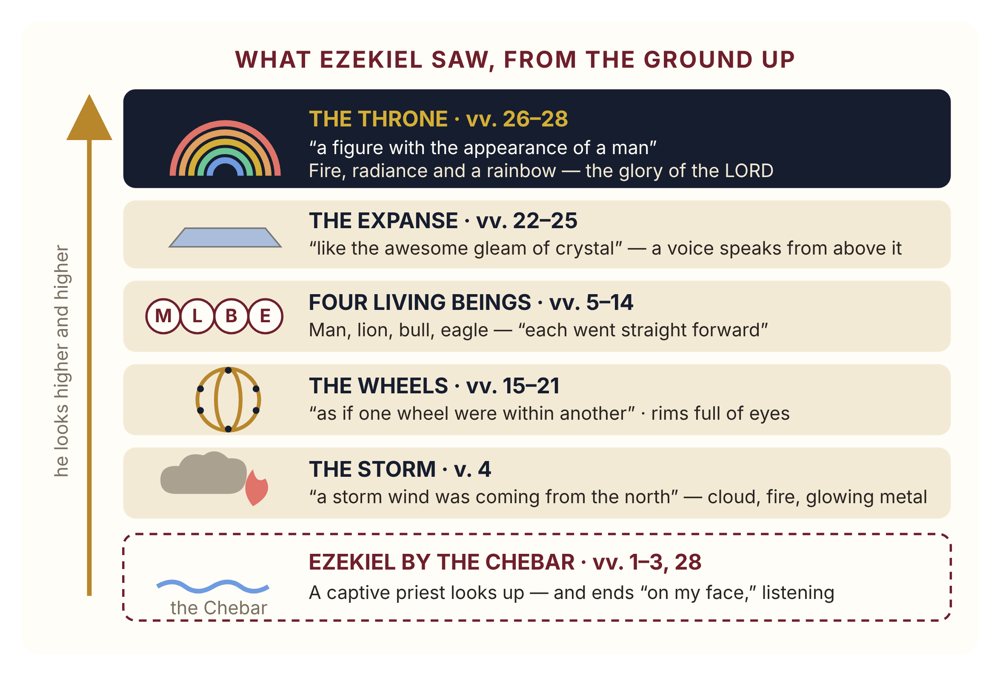
The Throne Above the Storm

God met a priest with no temple in the worst place of his life and showed him that His throne is not stuck in Jerusalem — it moves, it sees everything, and it rules over Babylon too. Seeing the glory put Ezekiel on his face, and that is where his ministry began.

“As the appearance of the rainbow in the clouds on a rainy day, so was the appearance of the surrounding radiance. Such was the appearance of the likeness of the glory of the LORD. And when I saw it, I fell on my face and heard a voice speaking.” Ezekiel 1:28
From the Ezekiel 3 study
Ezekiel 3

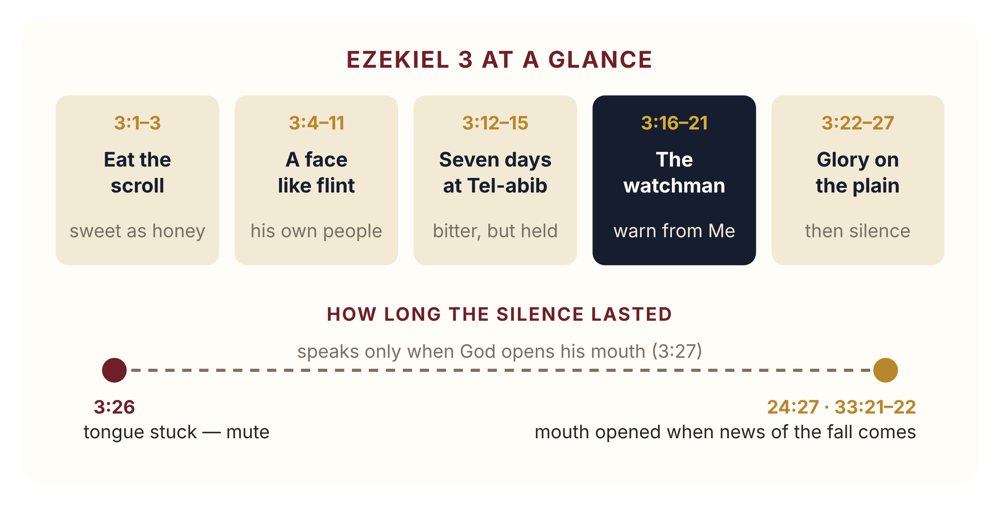
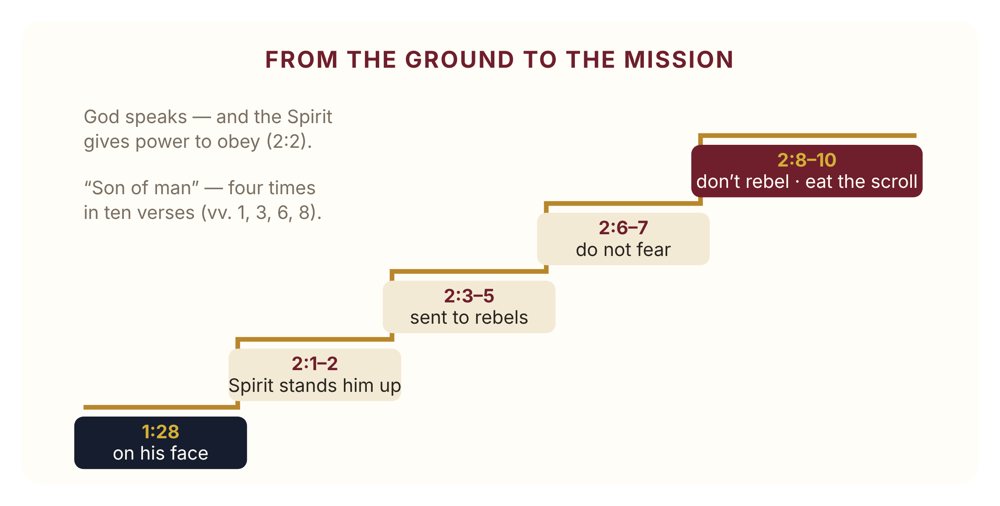
The Watchman: Eat the Word, Then Warn

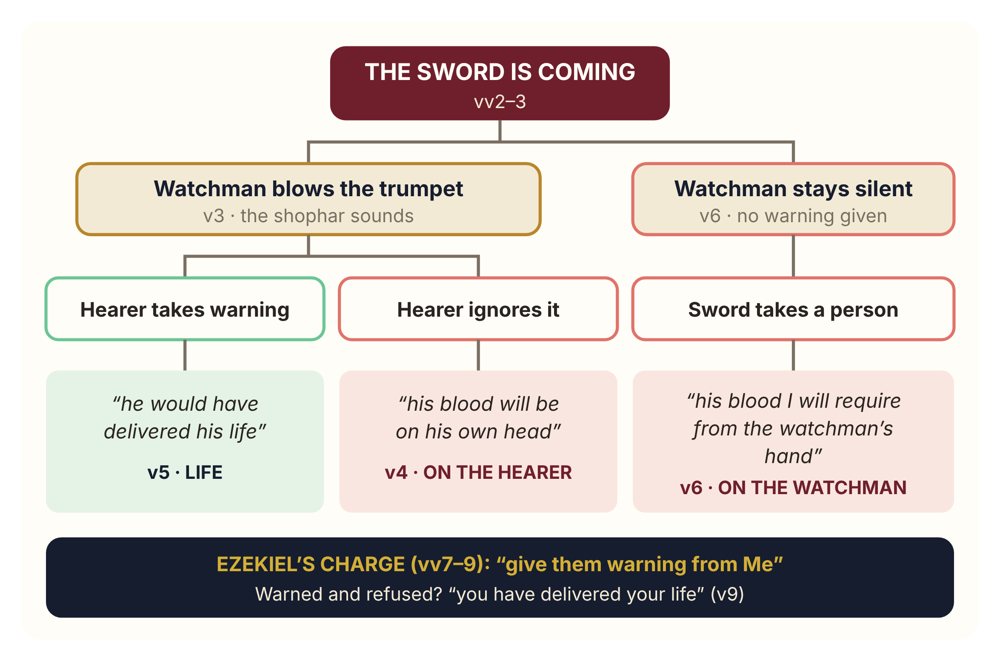
God’s man has to eat the Word before he can speak it, and he needs a face harder than the people he is sent to. His job is to be a watchman — warn the wicked, warn the righteous, and leave the response with them — and even the watchman speaks only when God opens his mouth.

“Son of man, I have appointed you a watchman to the house of Israel; whenever you hear a word from My mouth, warn them from Me.” Ezekiel 3:17

Signs against Jerusalem Ezekiel 4–7

From the Ezekiel 4 study
Ezekiel 4

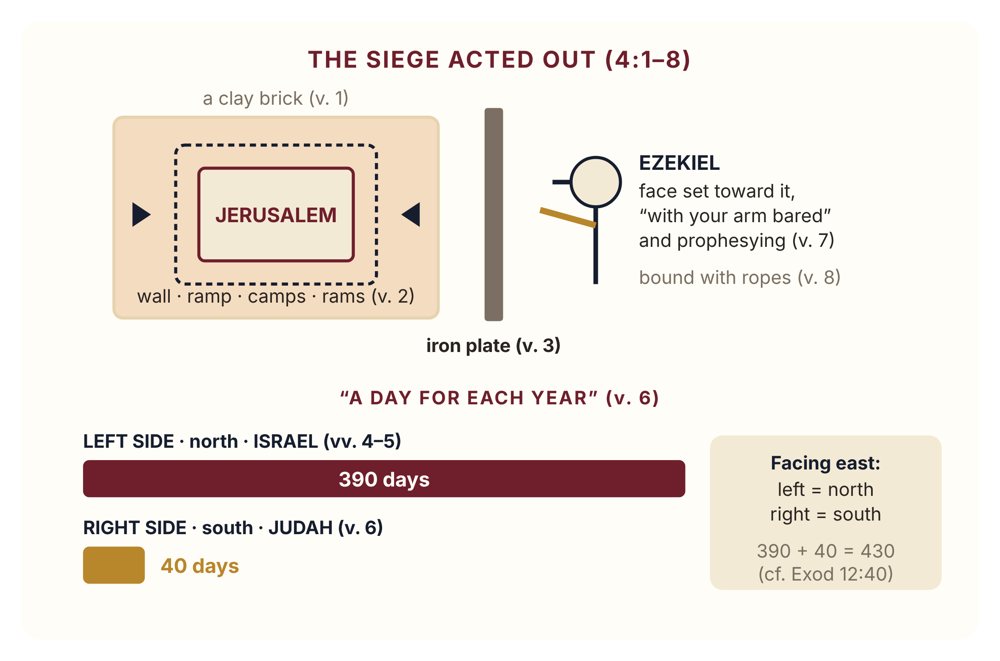
The Siege Acted Out: Bearing the Iniquity

God told Ezekiel to preach with his whole body — a brick, an iron plate, a bed and a ration of dung-baked bread said what the exiles didn’t want to hear: Jerusalem will not hold. Sin has a weight, somebody has to carry it, and God measured the days of judgment, a day for each year.

“When you have completed these, you shall lie down a second time, but on your right side and bear the iniquity of the house of Judah; I have assigned it to you for forty days, a day for each year.” Ezekiel 4:6
From the Ezekiel 5 study
Ezekiel 5

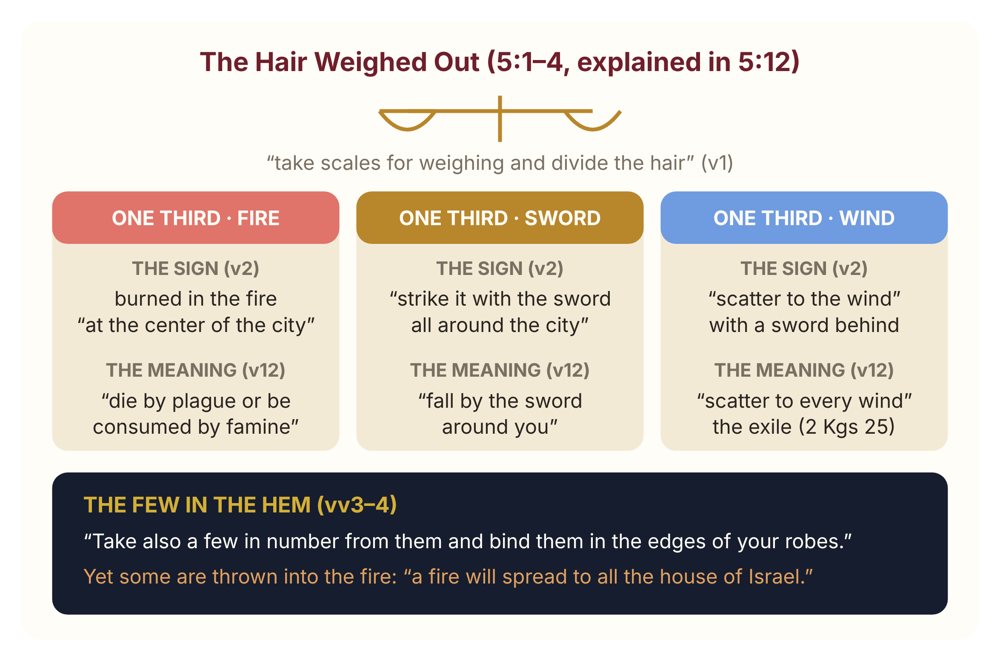
This Is Jerusalem: Judgment Weighed to the Hair

God shaved His people like a mourner shaves his head and weighed out their judgment to the hair. Jerusalem was placed at the center to show the nations what God is like, and instead she became worse than they were; yet even here, a few hairs are tucked into the prophet's robe.

“This is Jerusalem; I have set her at the center of the nations, with lands around her.” Ezekiel 5:5
From the Ezekiel 6 study
Ezekiel 6

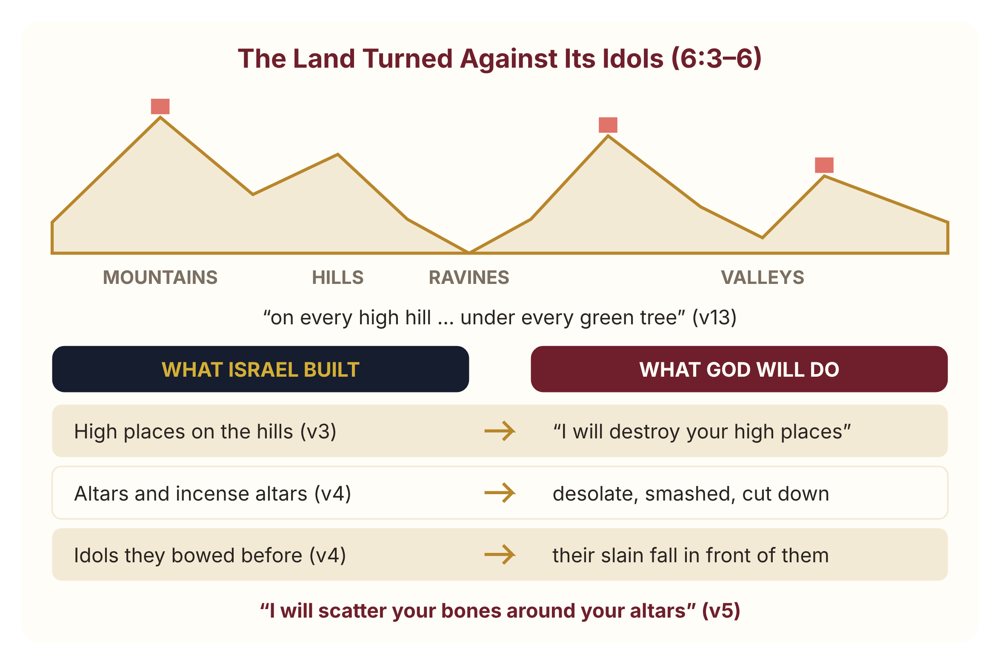
The Mountains of Israel: A Remnant Remembers

Israel filled God's mountains with altars to other gods, and God promised to fill those altars with the bones of the worshipers. But in exile a remnant would remember Him, see how deeply their unfaithfulness had wounded Him, hate the sin they once loved, and know that He is the LORD.

“Then those of you who escape will remember Me among the nations to which they will be carried captive, how I have been hurt by their adulterous hearts which turned away from Me, and by their eyes which played the harlot after their idols.” Ezekiel 6:9
From the Ezekiel 7 study
Ezekiel 7

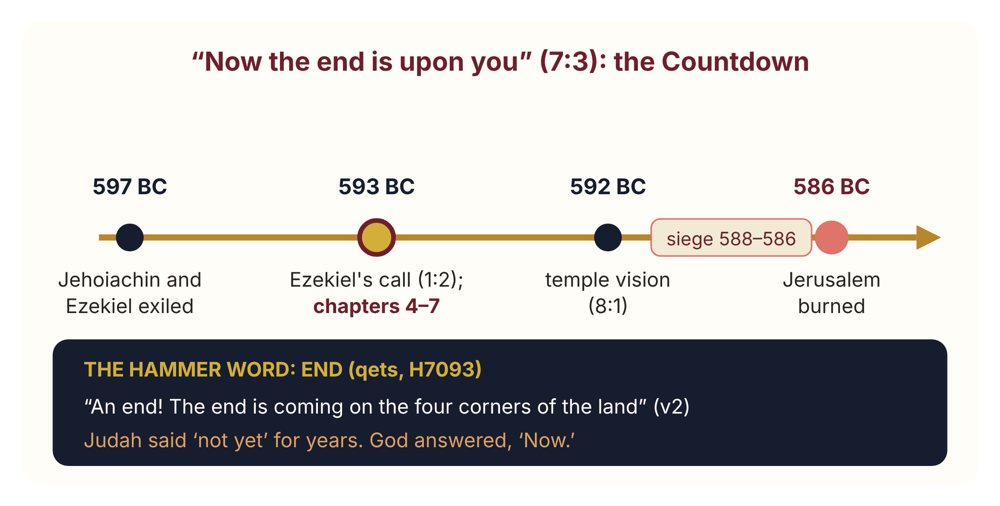
The End Has Come: When Patience Runs Out

God's patience is real, but it isn't endless; Judah kept saying ‘not yet,’ and God answered, ‘Now.’ When the end came, money couldn't buy a way out, soldiers couldn't fight and leaders had no word, and even in judgment God's aim was that they would finally know that He is the LORD.

“Now the end is upon you, and I will send My anger against you; I will judge you according to your ways and bring all your abominations upon you.” Ezekiel 7:3

The glory departs Ezekiel 8–11

From the Ezekiel 8 study
Ezekiel 8

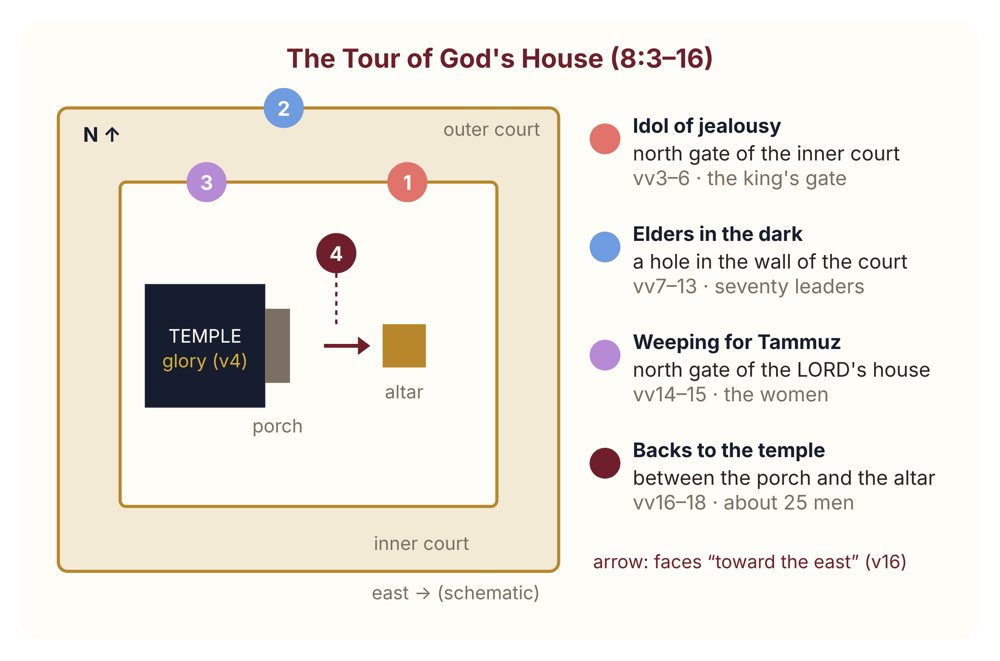
Behind the Wall: Abominations in God's House

God takes Ezekiel on a tour of His own house and shows him what the leaders thought no one could see: an idol at the gate, elders in a secret chamber, women weeping for a pagan god, men with their backs to the LORD. God's glory was still there, but the people had turned their backs on Him, and now He was about to leave.

“Son of man, do you see what the elders of the house of Israel are committing in the dark, each man in the room of his carved images? For they say, ‘The LORD does not see us; the LORD has forsaken the land.’” Ezekiel 8:12
From the Ezekiel 9 study
Ezekiel 9

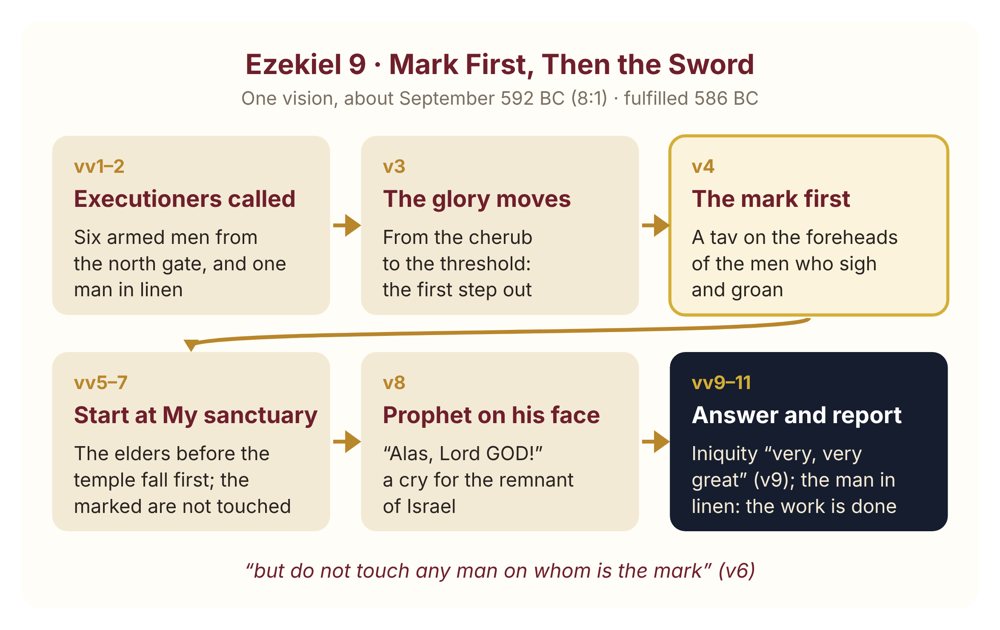
Marked Before the Sword

Before judgment falls, God marks His own; the only thing that set the marked apart was that they grieved over the sin around them instead of joining in. Judgment starts at God's house, the prophet falls on his face for mercy, and the man in linen finishes his work without losing one marked person.

“The LORD said to him, ‘Go through the midst of the city, even through the midst of Jerusalem, and put a mark on the foreheads of the men who sigh and groan over all the abominations which are being committed in its midst.’” Ezekiel 9:4
From the Ezekiel 10 study
Ezekiel 10

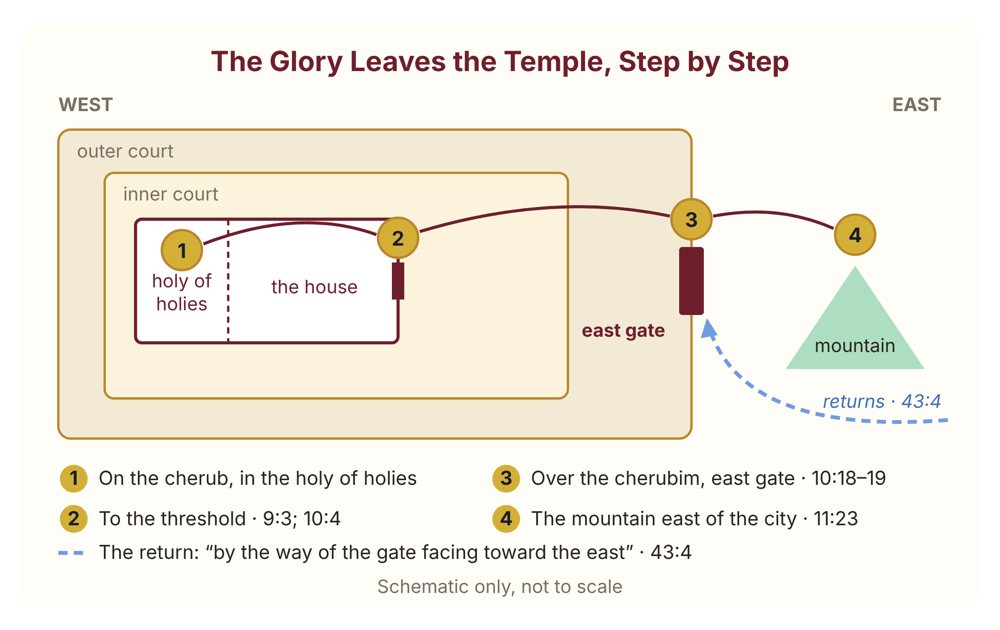
Fire From the Throne, Glory at the Gate

God does not leave His house in a hurry; the glory steps from the cherub to the threshold and then to the east gate, as if lingering for one more chance. But the same holy presence that once filled the temple now sends fire on a city that filled His house with idols, and His glory will not stay where it is despised.

“Then the glory of the LORD departed from the threshold of the temple and stood over the cherubim.” Ezekiel 10:18
From the Ezekiel 11 study
Ezekiel 11

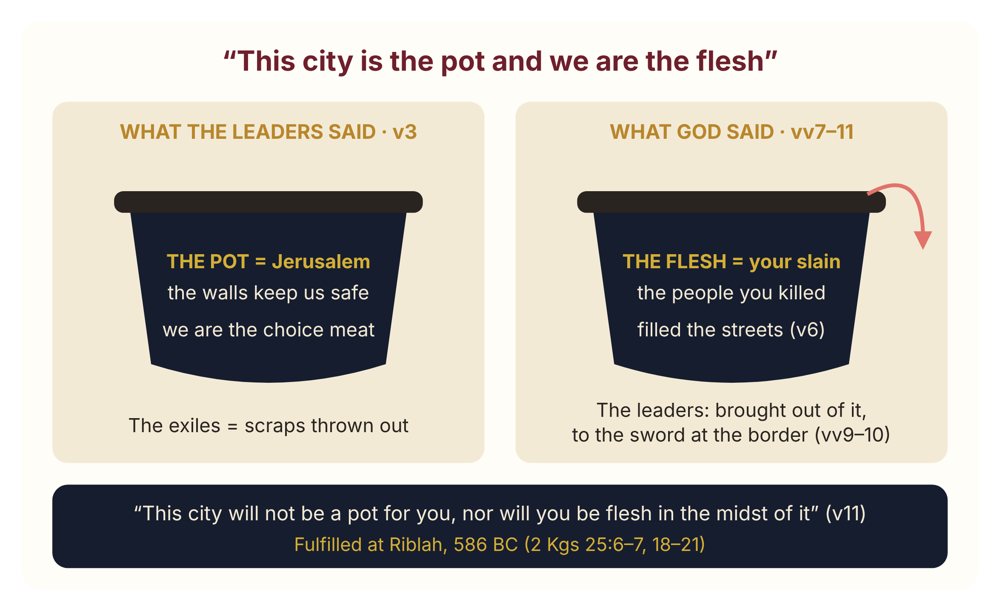
The Pot, the New Heart, the Mountain

The men who felt safest were closest to judgment, and the men who felt farthest from God were the ones He promised to meet. Religion, real estate and a good slogan could not protect Jerusalem's leaders, but to scattered, written-off exiles God promises Himself, a new spirit, and a heart of flesh in place of stone.

“And I will give them one heart, and put a new spirit within them. And I will take the heart of stone out of their flesh and give them a heart of flesh,” Ezekiel 11:19

Why the exile came Ezekiel 12–24

From the Ezekiel 12 study
Ezekiel 12

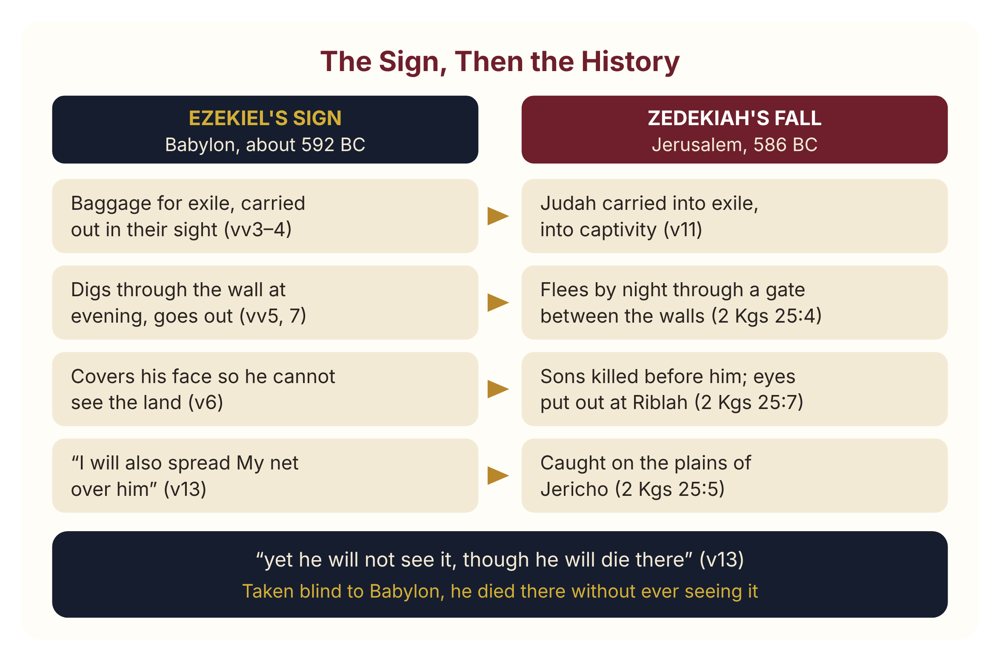
Baggage for Exile: No More Delay

People can stare at the truth and still not see it; God acted out the fall of Jerusalem in front of the exiles and named the king's escape and capture years ahead. Then He dismantled the two excuses that keep people from repenting, ‘It'll never happen’ and ‘Not yet,’ because His patience is not a broken promise: when He speaks, it will be done.

“For I the LORD will speak, and whatever word I speak will be performed. It will no longer be delayed, for in your days, O rebellious house, I will speak the word and perform it,” declares the Lord GOD.” Ezekiel 12:25
From the Ezekiel 13 study
Ezekiel 13

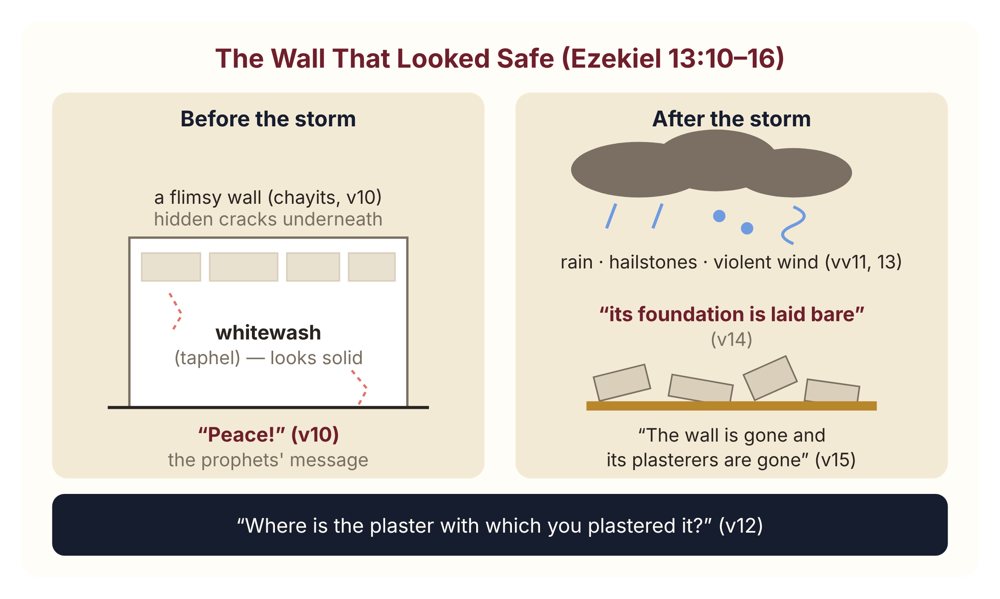
Whitewashed Walls: Peace When There Is No Peace

The most dangerous voice is the one that tells me what I want to hear and calls it God. These prophets painted over a cracked wall and called it safe, and God tore down the whitewash so His people could see the truth — to rescue them.

“It is definitely because they have misled My people by saying, ‘Peace!’ when there is no peace.” Ezekiel 13:10
From the Ezekiel 14 study
Ezekiel 14

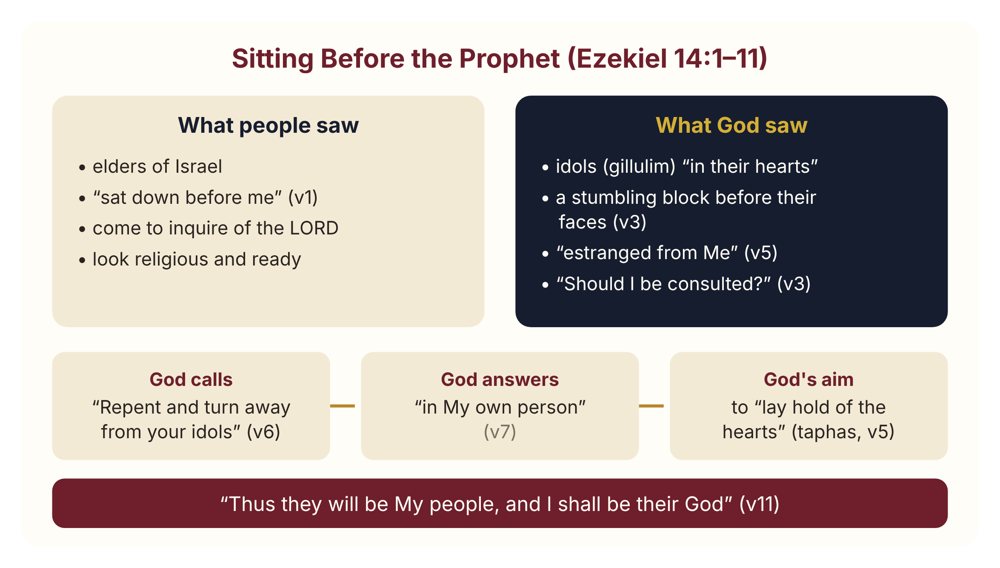
Idols in the Heart: Noah, Daniel and Job

I can sit in the right chair, in front of the right preacher, holding the right Bible, and still have an idol on the throne of my heart. God won't play along with a divided heart — He goes after the heart itself — and nobody else's faith can stand in for mine.

“Repent and turn away from your idols and turn your faces away from all your abominations.” Ezekiel 14:6
From the Ezekiel 15 study
Ezekiel 15

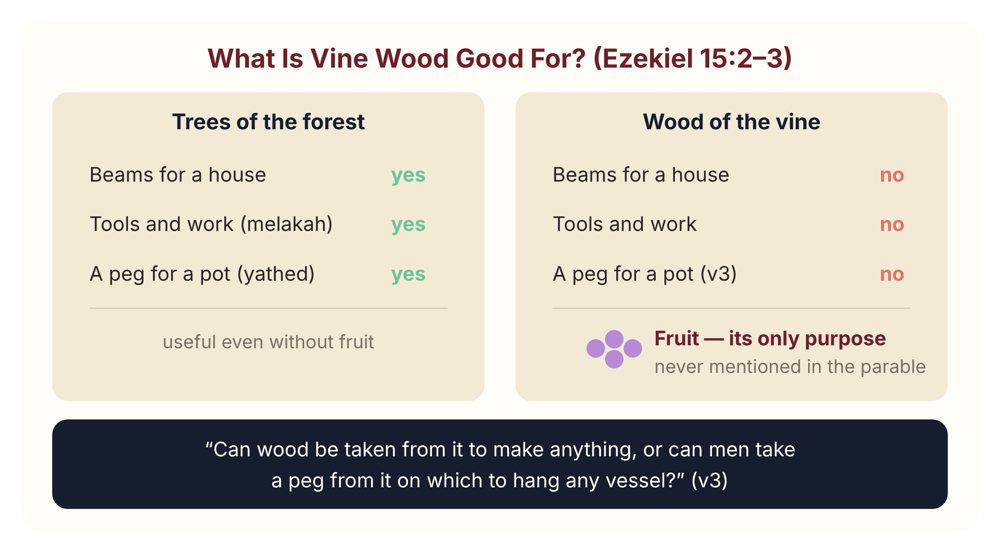
The Useless Vine: Fruitless Wood for the Fire

A vine has one purpose — fruit; its wood is too soft and crooked for anything else. When Israel stopped bearing fruit, the very thing they were proud of, being God's vine, left them good for nothing but the fire: privilege without fruit is not safety.

“As the wood of the vine among the trees of the forest, which I have given to the fire for fuel, so have I given up the inhabitants of Jerusalem” Ezekiel 15:6
From the Ezekiel 16 study
Ezekiel 16

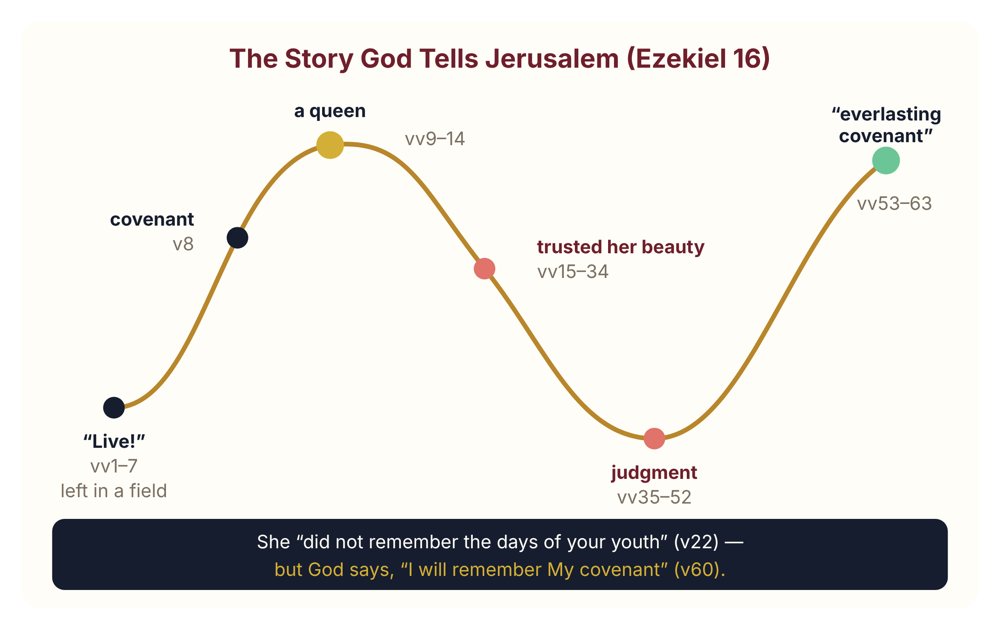
The Foundling Bride and the Everlasting Covenant

God found Jerusalem dying in a field and said “Live!” He married her, washed her and crowned her, and she gave His gifts to idols; the judgment is as hard as the sin, but the last word is grace — God remembers the covenant she forgot and forgives what she cannot undo.

“Nevertheless, I will remember My covenant with you in the days of your youth, and I will establish an everlasting covenant with you.” Ezekiel 16:60
From the Ezekiel 17 study
Ezekiel 17

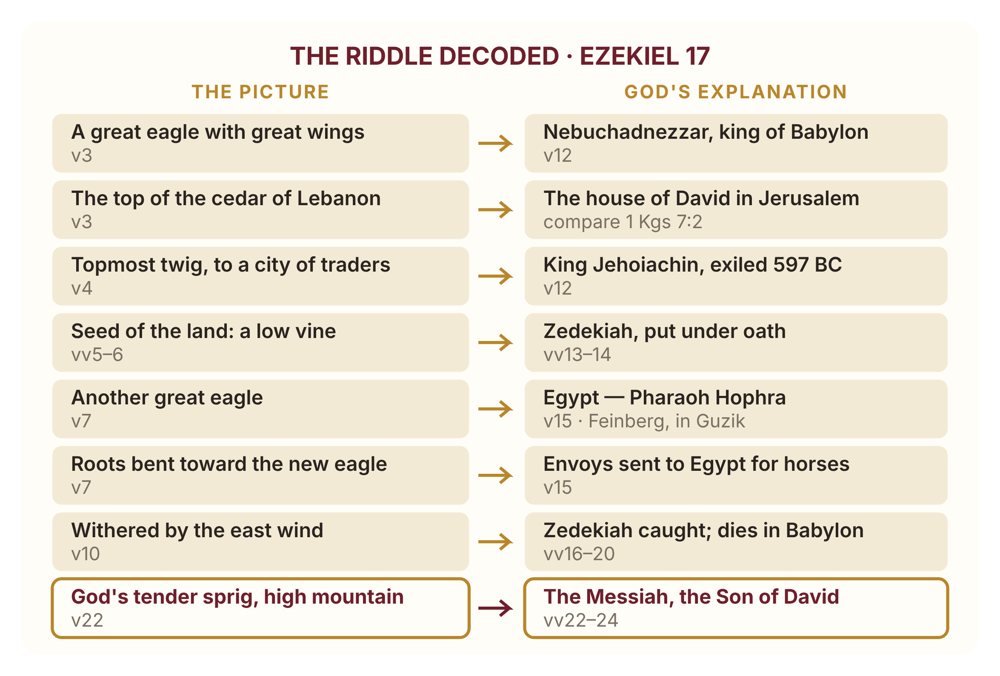
Two Eagles, a Vine and a Tender Shoot

Zedekiah gave his word under God's name and broke it, reaching for Egypt instead of trusting God — and a broken oath is broken with God, so no one escapes by it. But where human kings fail, God Himself will plant a tender shoot from David's line on His mountain, and it will become a cedar that shelters all kinds of people.

“All the trees of the field will know that I am the LORD; I bring down the high tree, exalt the low tree, dry up the green tree and make the dry tree flourish. I am the LORD; I have spoken, and I will perform it.” Ezekiel 17:24
From the Ezekiel 18 study
Ezekiel 18

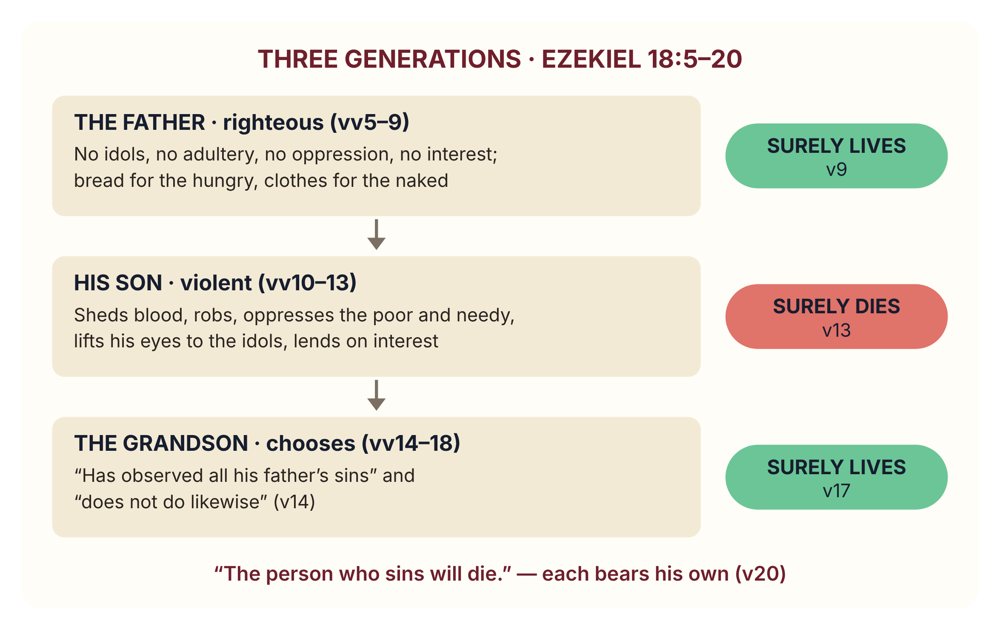
Sour Grapes: Every Soul Is Mine

No one gets to blame his father for his own sin, and no one is doomed by his father's sin either; every soul belongs to God and answers to Him directly. God takes no pleasure in anyone's death, and He calls every man, whatever his family or past, to turn and live.

“For I have no pleasure in the death of anyone who dies,” declares the Lord GOD. “Therefore, repent and live.” Ezekiel 18:32
From the Ezekiel 19 study
Ezekiel 19

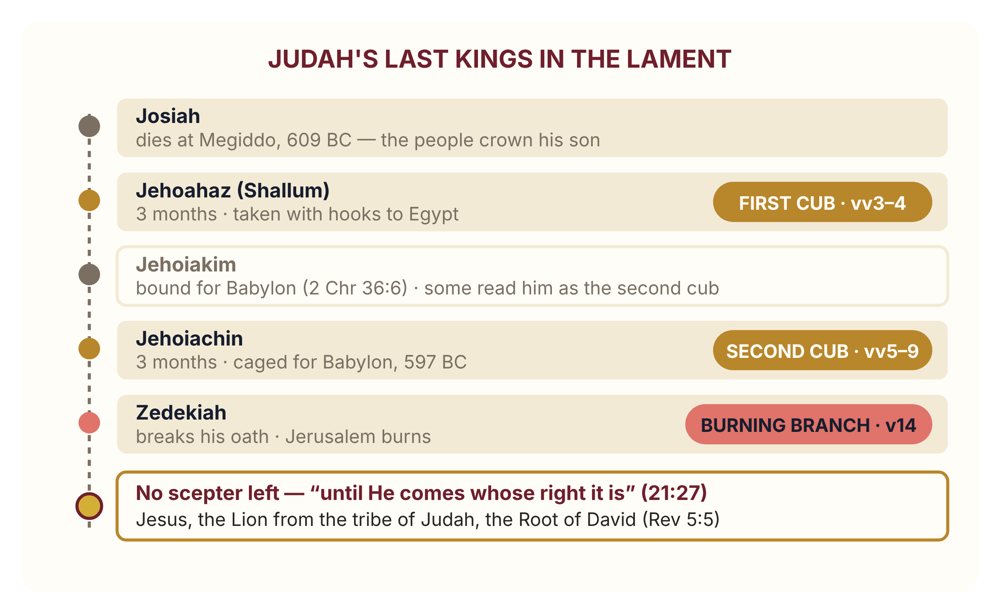
Lament for the Princes: Lions Caged, Vine Burned

God has Ezekiel sing a funeral song over the kings of Judah while one of them is still on the throne: the lions learned to devour and the nations caged them, and the rich, tall vine was burned down by fire from its own branch. When leaders reject God's Word, the nation they lead pays for it — and the only thing left to do is weep.

“And fire has gone out from its branch; It has consumed its shoots and fruit, So that there is not in it a strong branch, A scepter to rule.” Ezekiel 19:14
From the Ezekiel 20 study
Ezekiel 20

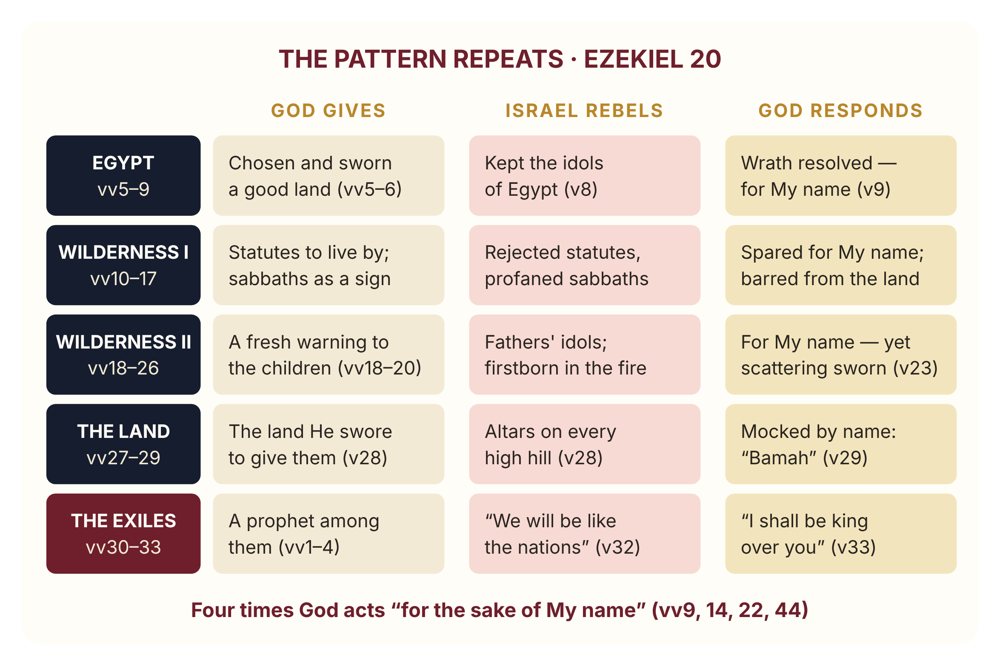
For My Name's Sake: Rebellion, Mercy, the Rod

Men came to ask God for a word while their hearts were still full of idols, and God answered with their own history — rebellion in Egypt, in the wilderness and in the land — while over and over He held back judgment for the sake of His name. He will not be used, and He will not let His people go: He will bring them through the wilderness, under the rod and into the covenant, until they loathe their sin and know that He is the LORD.

“Then you will know that I am the LORD when I have dealt with you for My name’s sake, not according to your evil ways or according to your corrupt deeds, O house of Israel,” declares the Lord GOD.” Ezekiel 20:44
From the Ezekiel 21 study
Ezekiel 21

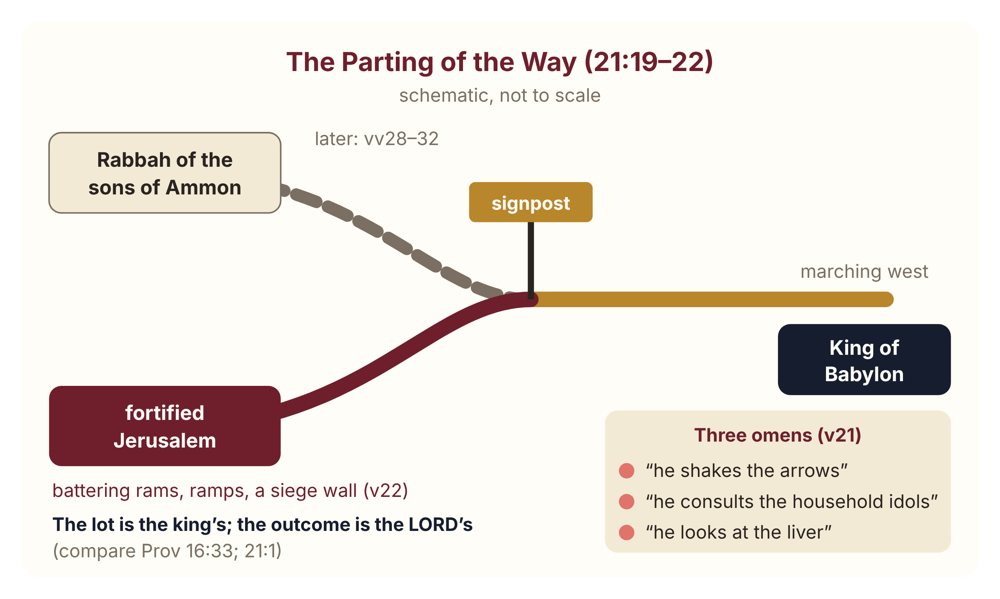
The Sword Unsheathed: Until He Comes

The parable becomes a plain word: God's own sword is out of its sheath, and it won't go back until Jerusalem falls. A pagan king shakes arrows at a crossroads, but God is steering him; the last son of David loses his crown, yet the crown waits for the One whose right it is.

“A ruin, a ruin, a ruin, I will make it. This also will be no more until He comes whose right it is, and I will give it to Him.” Ezekiel 21:27
From the Ezekiel 22 study
Ezekiel 22

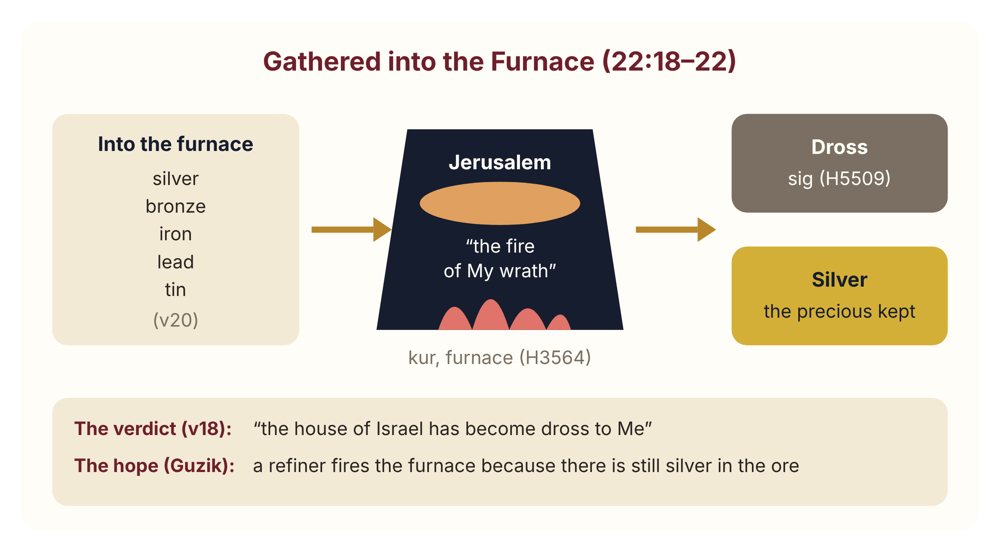
No One in the Gap

Jerusalem had forgotten God, and everything else came apart — families, courts, worship, money, leadership; from the palace to the pulpit to the street, no one was clean. God was ready to melt the whole city in His furnace, and He looked for one man to stand in the gap and found none.

“I searched for a man among them who would build up the wall and stand in the gap before Me for the land, so that I would not destroy it; but I found no one.” Ezekiel 22:30
From the Ezekiel 23 study
Ezekiel 23

Two Sisters: Oholah and Oholibah

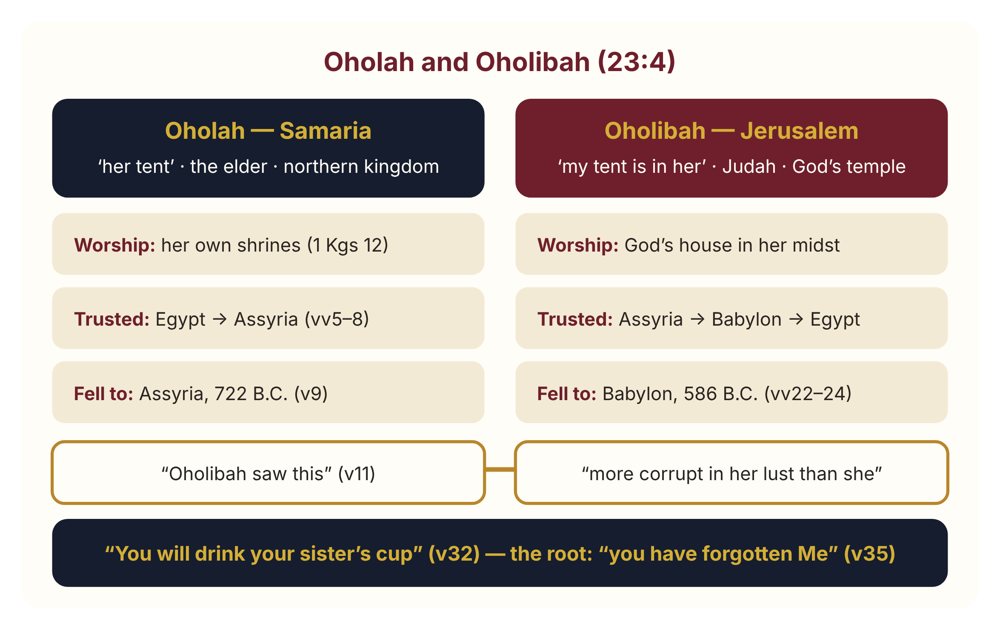
God took Israel as His own, and she went looking for other lovers — Egypt, Assyria, then Babylon — trusting armies and idols instead of Him; Jerusalem watched her sister destroyed for it and did worse. Sin always promises a lover and ends as a tyrant, and the root of it all is forgetting God and throwing Him behind our back.

“Therefore, thus says the Lord GOD, ‘Because you have forgotten Me and cast Me behind your back, bear now the punishment of your lewdness and your harlotries.’” Ezekiel 23:35
From the Ezekiel 24 study
Ezekiel 24

The Rusted Pot and the Prophet’s Loss

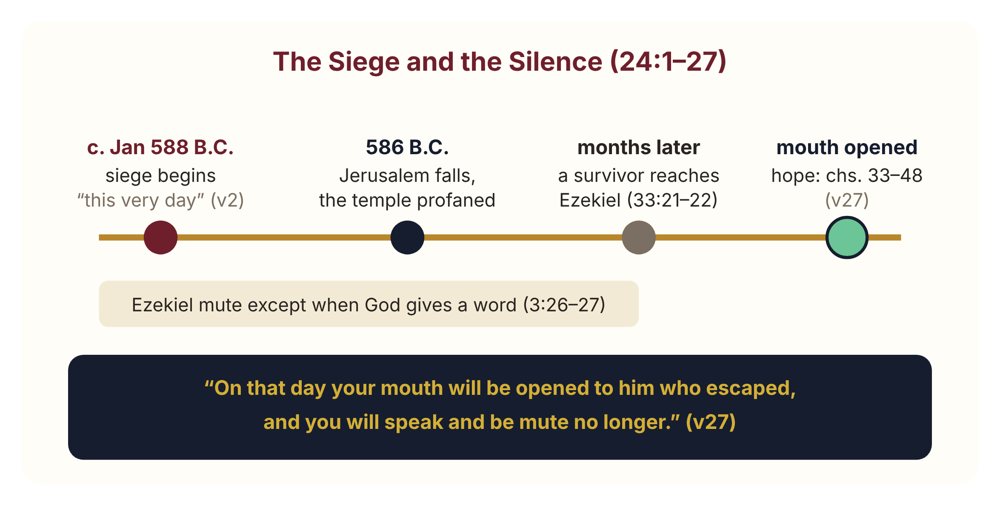
The day the siege began, God told Ezekiel to mark the calendar: Jerusalem was a rusted pot that no scrubbing had cleaned, so the fire would burn until the rust was gone. Then God took Ezekiel’s wife, the desire of his eyes, and told him not to mourn, so the exiles would understand the temple they trusted was about to be taken just as suddenly — and Ezekiel obeyed the next morning.

“So I spoke to the people in the morning, and in the evening my wife died. And in the morning I did as I was commanded.” Ezekiel 24:18

Oracles against the nations Ezekiel 25–32

From the Ezekiel 25 study
Ezekiel 25

Gloating Neighbors: Ammon, Moab, Edom, Philistia

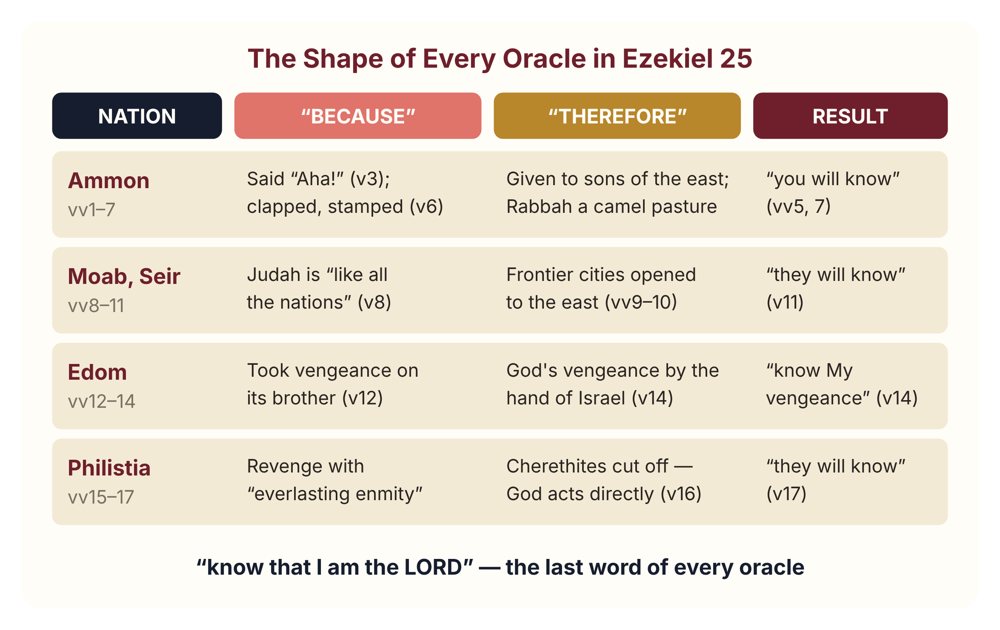
God judged His own people first, but He did not forget the nations who cheered when they fell. Mocking, gloating and revenge against God's people are sins against God Himself, and every “because” in this chapter ends the same way: they will know that He is the LORD.

“I will execute great vengeance on them with wrathful rebukes; and they will know that I am the LORD when I lay My vengeance on them.” Ezekiel 25:17
From the Ezekiel 26 study
Ezekiel 26

Greedy Tyre: Scraped to Bare Rock

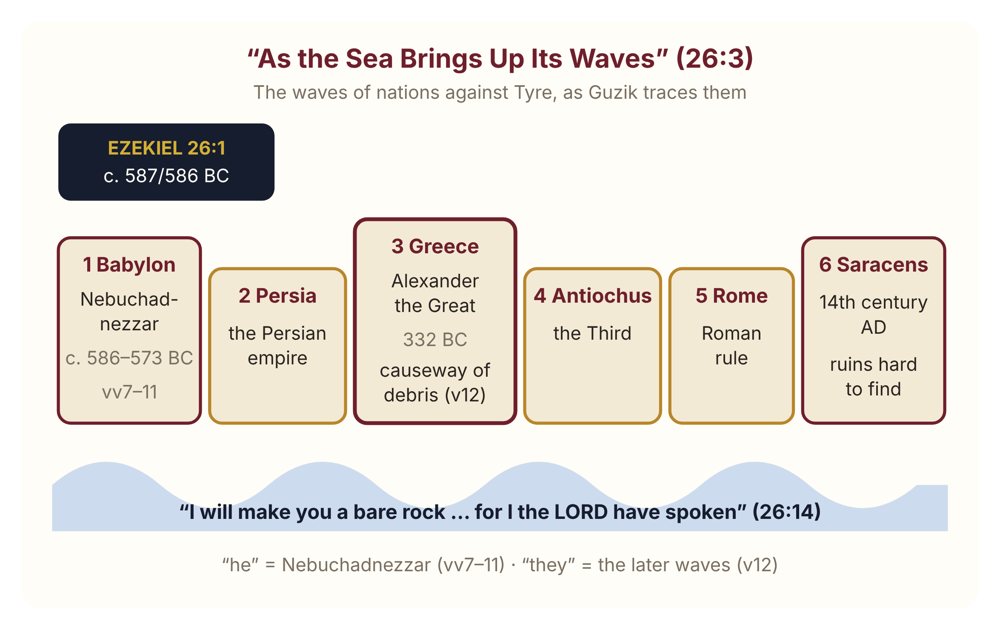
Tyre saw Jerusalem's ruin as a business opportunity, and God answered with wave after wave of judgment until the proud city was scraped down to bare rock. Profit at someone else's expense is not success; God is against the greed that cheers another's fall.

“Behold, I am against you, O Tyre, and I will bring up many nations against you, as the sea brings up its waves.” Ezekiel 26:3
From the Ezekiel 27 study
Ezekiel 27

The Shipwreck of Tyre: The Proud Ship

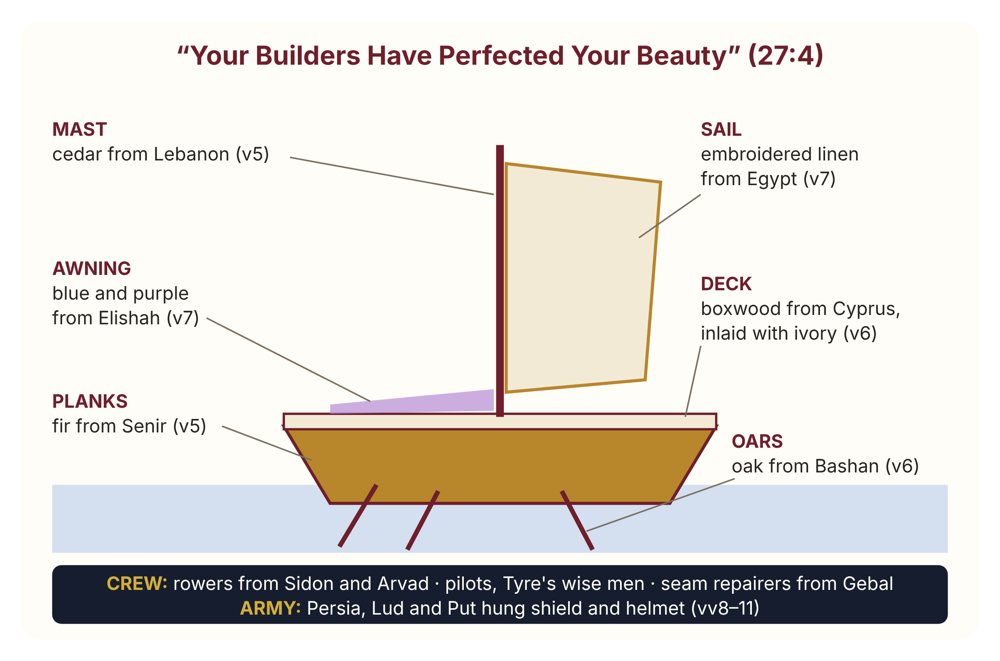
Tyre was the finest ship on the sea — beautiful, rich, well crewed, and sure of herself — and one east wind sent it all to the bottom. A life built on wealth and reputation, with God left off the manifest, is one storm away from the deep.

“Your rowers have brought you Into great waters; The east wind has broken you In the heart of the seas.” Ezekiel 27:26
From the Ezekiel 28 study
Ezekiel 28

The Fall of the Proud King

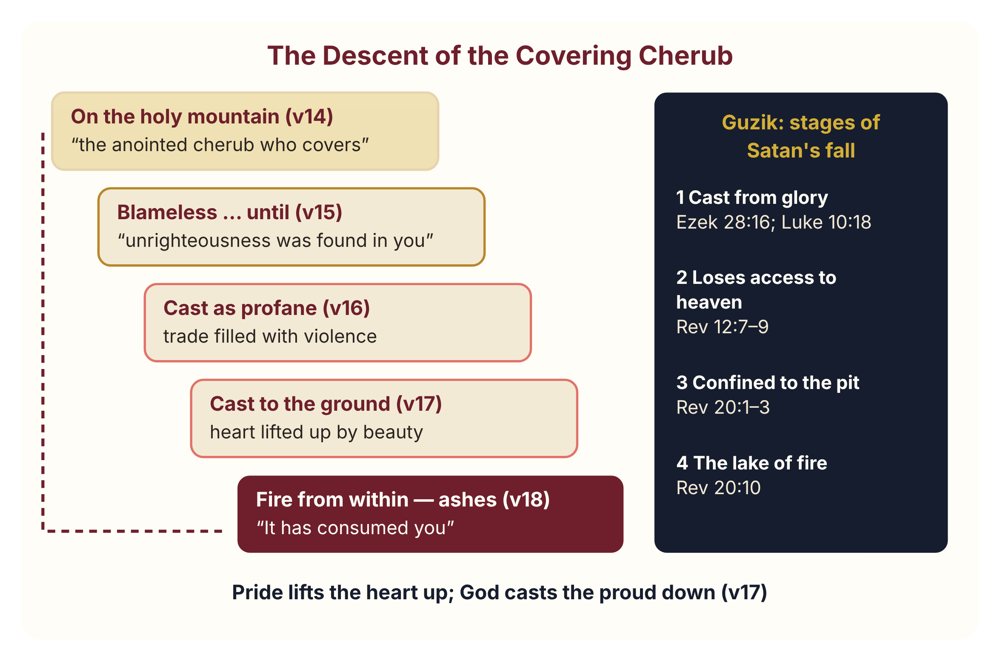
Pride says “I am a god” — and behind every proud throne stands the first proud rebel. God tears down the one who lifts himself up, but He gathers His humbled people and lets them live in safety, so that everyone will know He alone is the LORD.

“Your heart was lifted up because of your beauty; You corrupted your wisdom by reason of your splendor. I cast you to the ground; I put you before kings, That they may see you.” Ezekiel 28:17
From the Ezekiel 29 study
Ezekiel 29

The Monster in the Nile: Egypt’s Broken Reed

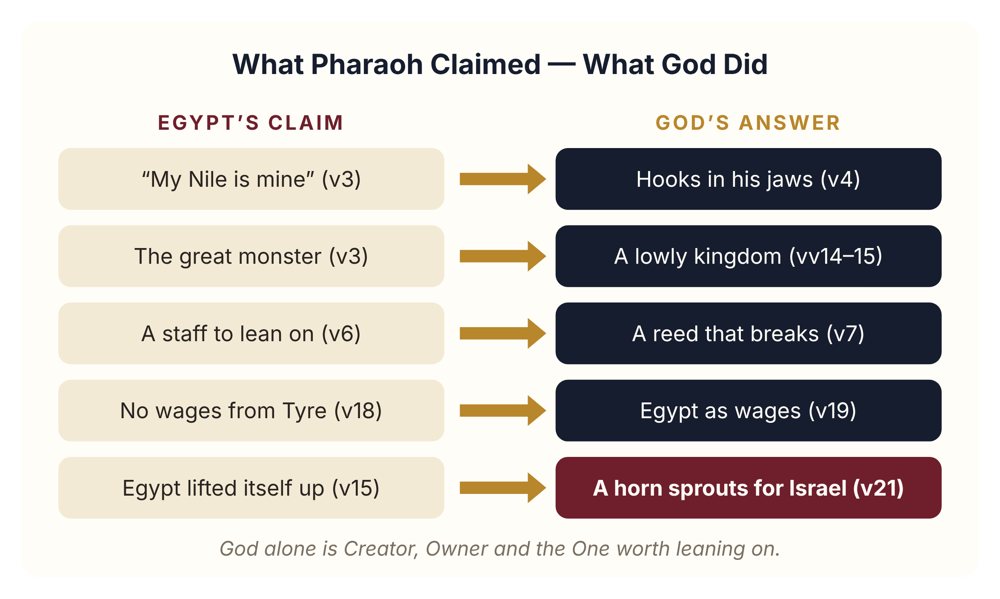
Pharaoh claimed to own and even create the river that made him, and God hooked him like a crocodile and laid him on the sand. God alone is Creator, Owner and the One worth leaning on, and He uses even pagan armies to do His work.

“Then all the inhabitants of Egypt will know that I am the LORD, Because they have been only a staff made of reed to the house of Israel.” Ezekiel 29:6
From the Ezekiel 30 study
Ezekiel 30

The Day of the LORD: Pharaoh’s Broken Arm

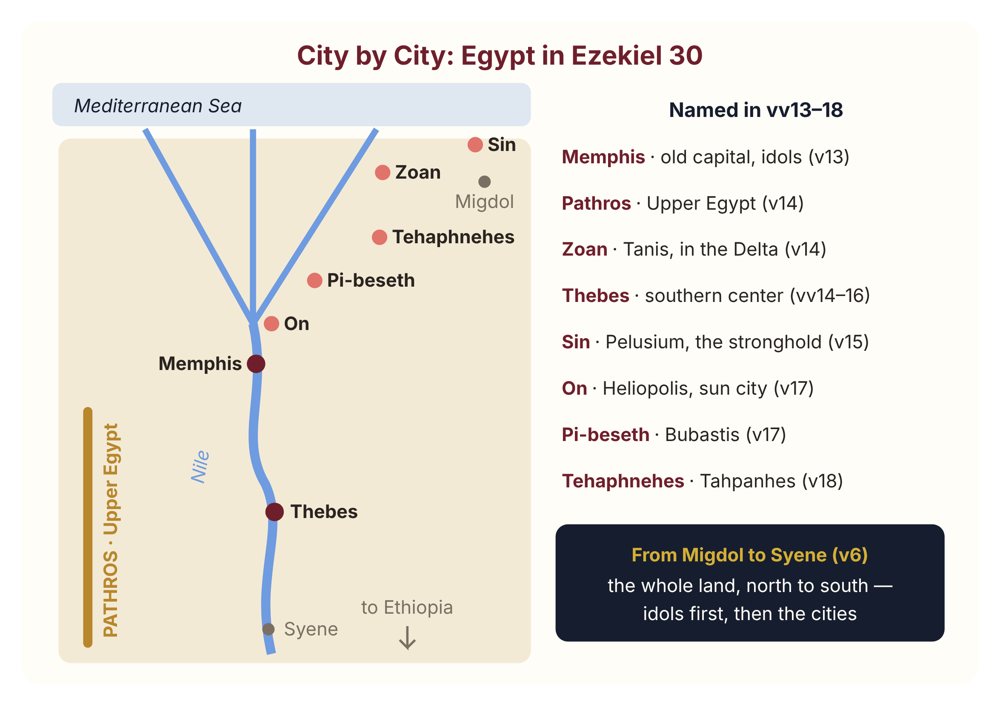
The day of the LORD came to Egypt — its idols, its cities, its allies and its king. God broke Pharaoh’s arm and put His own sword in Babylon’s hand; whoever is strong, God made strong, and whoever is broken, no one can bind up but Him.

“For I will strengthen the arms of the king of Babylon and put My sword in his hand; and I will break the arms of Pharaoh, so that he will groan before him with the groanings of a wounded man.” Ezekiel 30:24
From the Ezekiel 31 study
Ezekiel 31

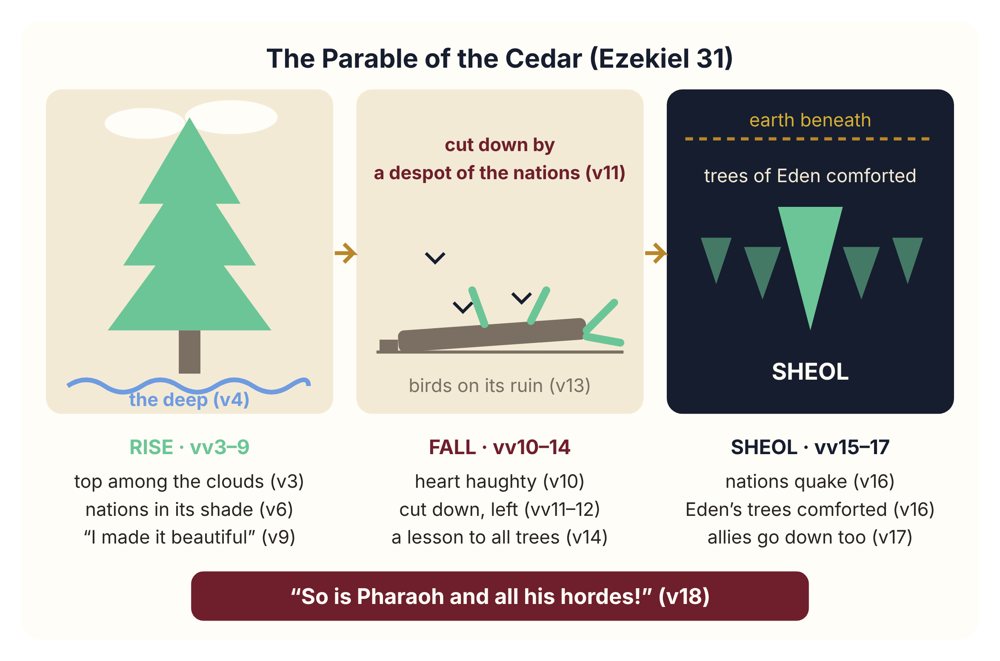
The Fallen Cedar: Pride Topples the Tallest Tree

God tells Pharaoh to look at Assyria — the tallest tree in the forest, fed by deep waters, sheltering the nations — and then look at the stump. God made it great, pride brought it down, and Egypt will fall the same way: height is a gift from God, never a fortress against Him.

“To which among the trees of Eden are you thus equal in glory and greatness? Yet you will be brought down with the trees of Eden to the earth beneath; you will lie in the midst of the uncircumcised, with those who were slain by the sword. So is Pharaoh and all his hordes!” Ezekiel 31:18
From the Ezekiel 32 study
Ezekiel 32

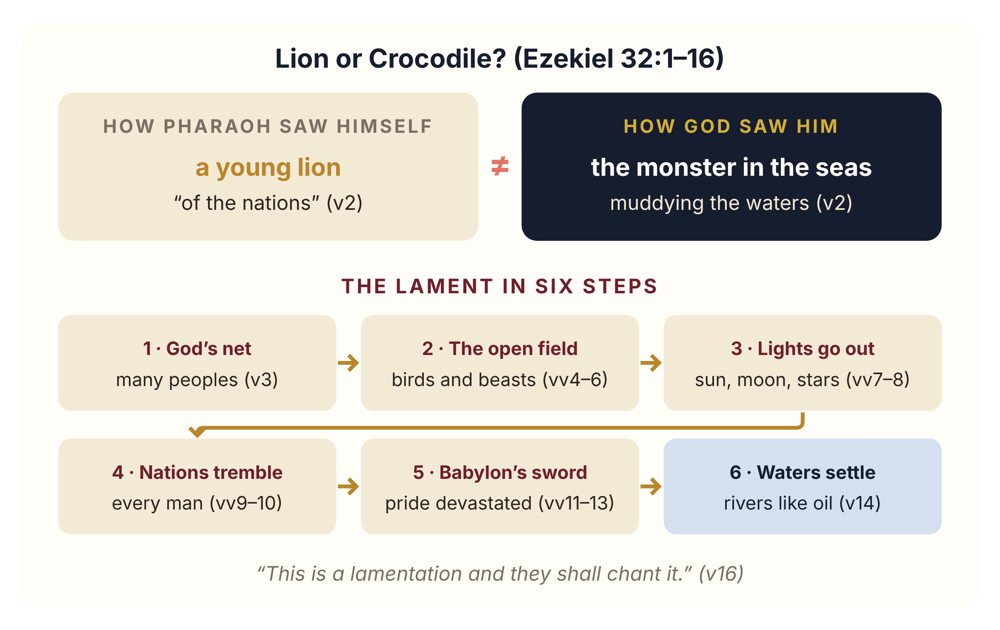
The Monster in the Net: Egypt’s Funeral Song

God writes Pharaoh’s funeral song while Pharaoh is still alive: the king who saw himself as a lion is really a thrashing crocodile, and God will haul him out in His net. Then Ezekiel walks us through the graveyard of empires — every one once feared, every one now lying in shame — and Pharaoh’s only comfort is that he has company.

“Though I instilled a terror of him in the land of the living, yet he will be made to lie down among the uncircumcised along with those slain by the sword, even Pharaoh and all his hordes.” Ezekiel 32:32

The watchman and the Shepherd Ezekiel 33–36

From the Ezekiel 33 study
Ezekiel 33

The Watchman on the Wall: Turn and Live

God sets a watchman on the wall and makes him responsible to sound the alarm, and makes every hearer responsible to respond; to men who feel they are rotting away in their sins, He swears by His own life that He takes no pleasure in their death: turn and live. Then the city falls, the prophet’s mouth opens, and God exposes two kinds of people who still don’t get it — the ones claiming promises while living in sin, and the ones who love to hear sermons but never obey them.

“Say to them, ‘As I live!’ declares the Lord GOD, ‘I take no pleasure in the death of the wicked, but rather that the wicked turn from his way and live. Turn back, turn back from your evil ways! Why then will you die, O house of Israel?’” Ezekiel 33:11
From the Ezekiel 34 study
Ezekiel 34

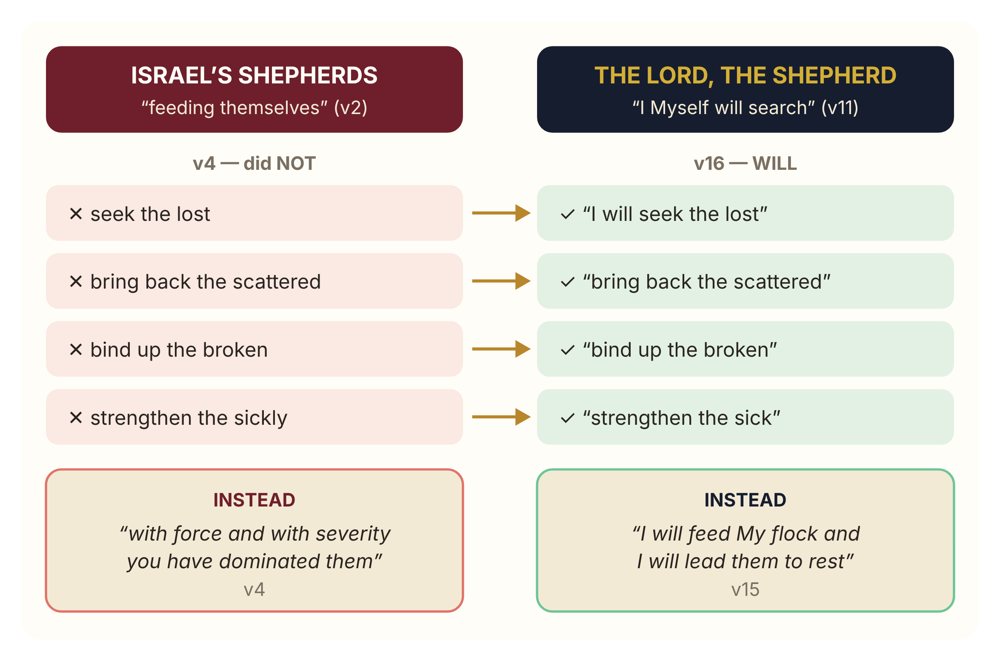
The Shepherds and the Good Shepherd

God’s flock was scattered because the men who should have cared for them only cared for themselves, so God fires the shepherds and takes the job Himself — searching for the lost, binding up the broken, and setting His own Shepherd over them. The bad leaders don’t get the last word; the good Shepherd does.

“I will seek the lost, bring back the scattered, bind up the broken and strengthen the sick; but the fat and the strong I will destroy. I will feed them with judgment.” Ezekiel 34:16
From the Ezekiel 35 study
Ezekiel 35

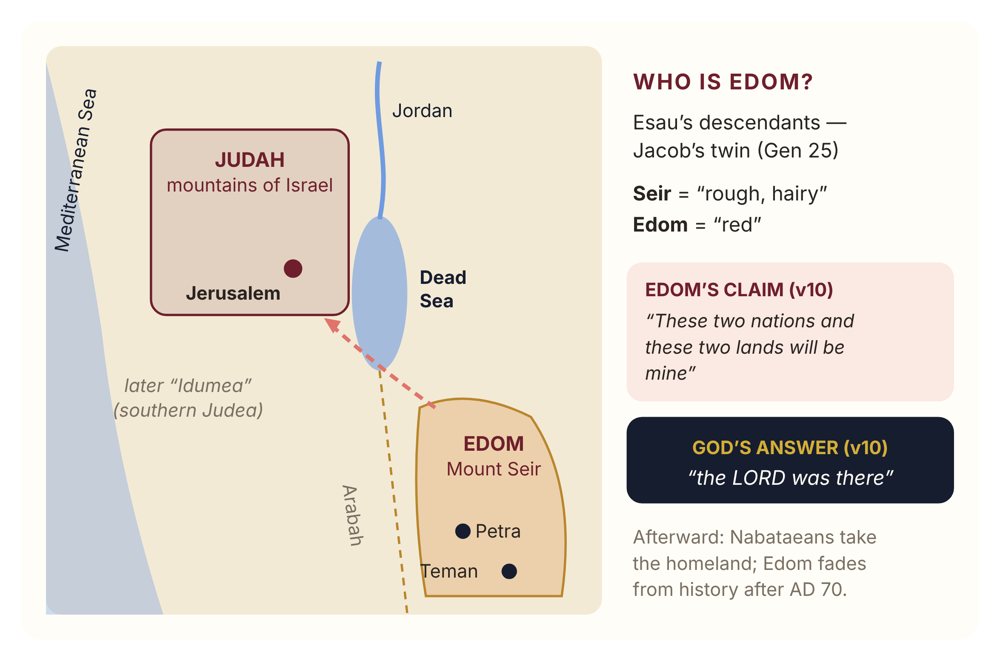
Against Mount Seir: The LORD Was There

Edom nursed a grudge for a thousand years, kicked his brother when he was down, and then tried to take his land — but the land was never empty; the LORD was there. Hatred, envy and gloating come back on the one who carries them, and God hears every word spoken against His people.

“Because you have said, ‘These two nations and these two lands will be mine, and we will possess them,’ although the LORD was there,” Ezekiel 35:10
From the Ezekiel 36 study
Ezekiel 36

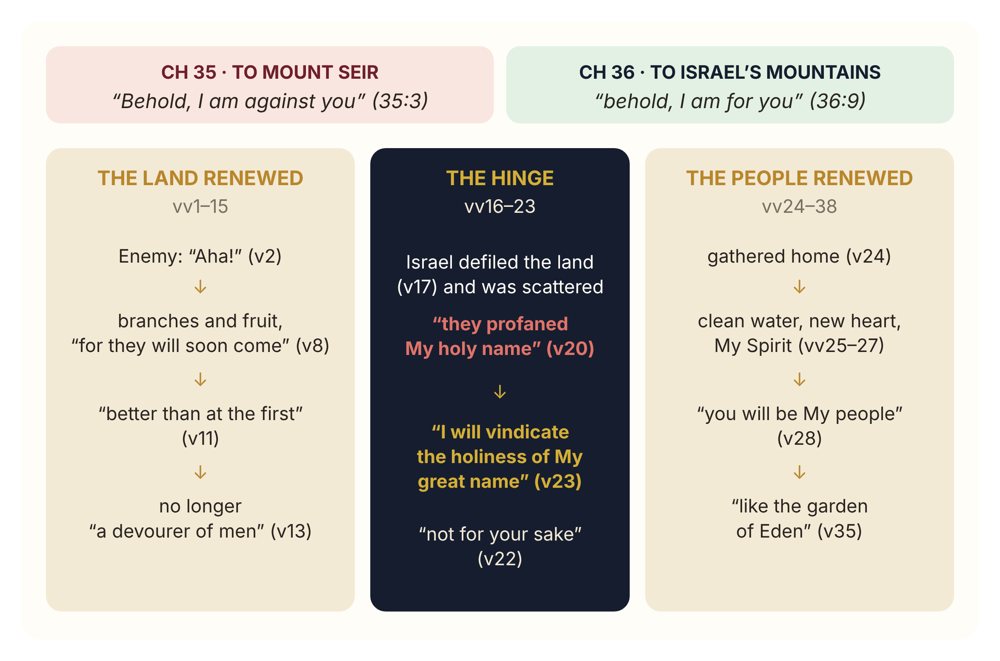
A New Heart for His Name’s Sake

Israel gave God’s name a black eye among the nations, and God’s answer was not to give up on them but to change them from the inside — washing them, giving them a new heart, putting His own Spirit in them, and rebuilding the ruins until they look like Eden. He does it for His name, which is the only reason a man like me has any hope.

“Moreover, I will give you a new heart and put a new spirit within you; and I will remove the heart of stone from your flesh and give you a heart of flesh.” Ezekiel 36:26

Dry bones and Gog Ezekiel 37–39

From the Ezekiel 37 study
Ezekiel 37

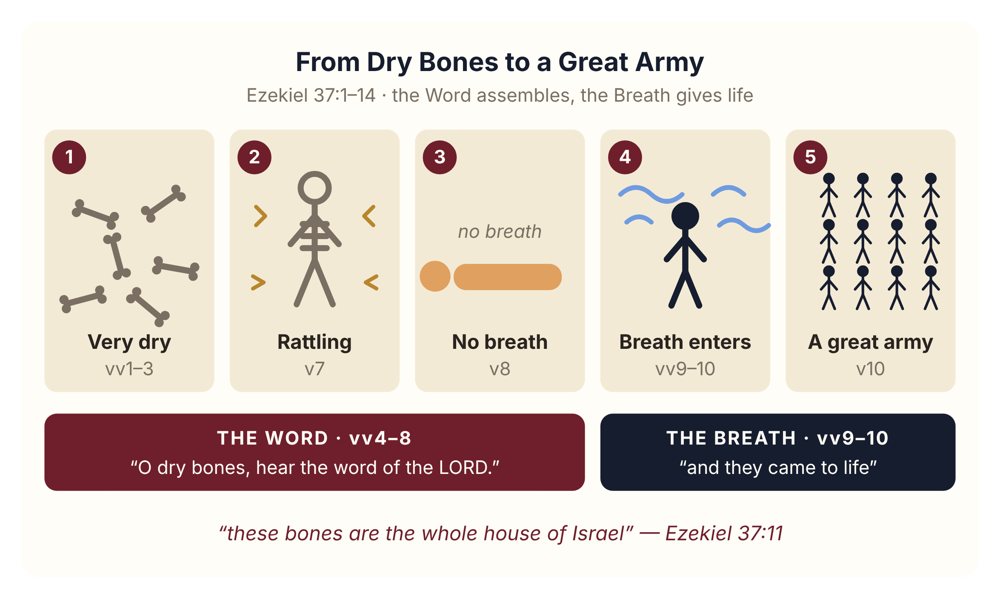
Dry Bones Live: One Stick, One Shepherd

God took Ezekiel to the deadest place imaginable and asked if it could live. The Word put the bones together, but only the Breath of God made them stand — and a people who said “our hope has perished” are raised, reunited under one Shepherd, cleansed, and given God’s own presence forever.

“I will put My Spirit within you and you will come to life, and I will place you on your own land.” Ezekiel 37:14
From the Ezekiel 38 study
Ezekiel 38

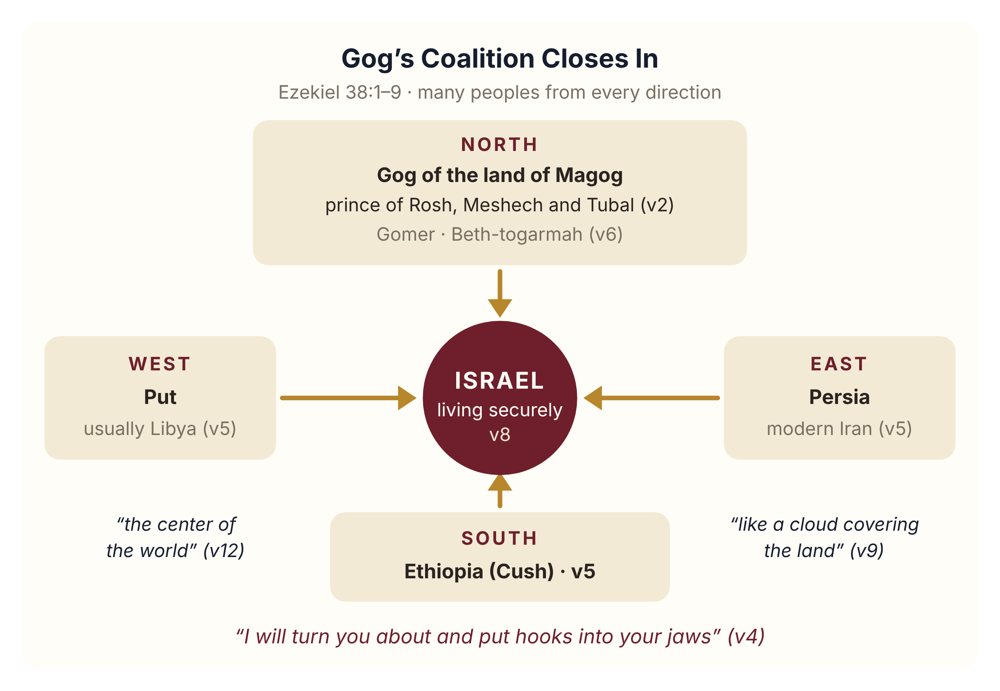
Gog of Magog: The Last Great Coalition

When God’s people are finally at peace, the biggest coalition yet comes to swallow them. But Gog never had the upper hand — God put the hooks in his jaws and led him to his own ruin, so that the nations will know the LORD.

“I will magnify Myself, sanctify Myself, and make Myself known in the sight of many nations; and they will know that I am the LORD.” Ezekiel 38:23
From the Ezekiel 39 study
Ezekiel 39

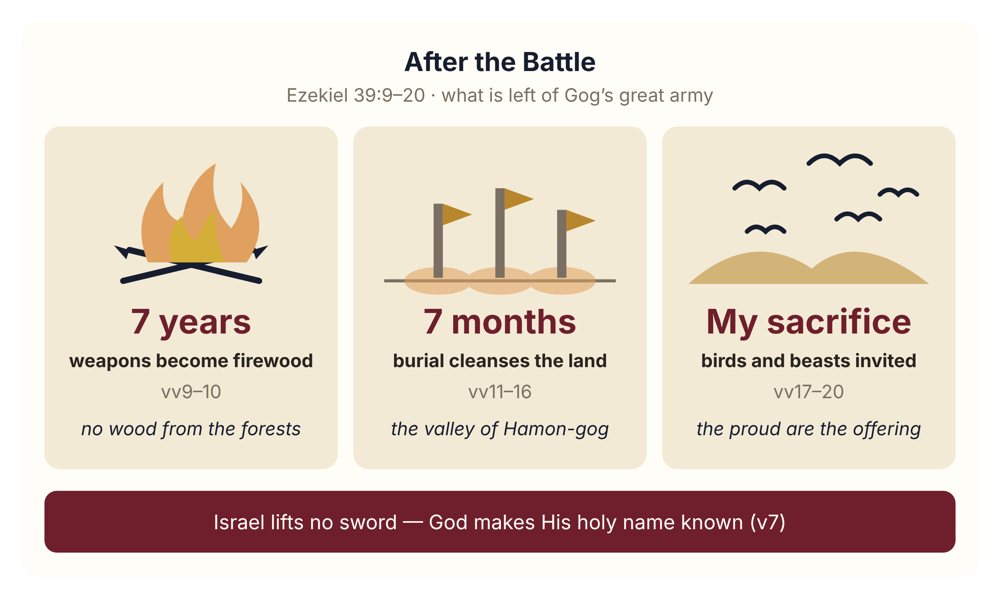
Gog’s Defeat and God’s Holy Name

The enemy that came to plunder becomes firewood, graves and food for the birds, and God’s holy name is made known. Then God explains that Israel went into exile for its own sin, not His weakness — and His last word is mercy: no one left behind, His face no longer hidden, His Spirit poured out.

“I will not hide My face from them any longer, for I will have poured out My Spirit on the house of Israel.” Ezekiel 39:29

The glory returns Ezekiel 40–48

From the Ezekiel 40 study
Ezekiel 40

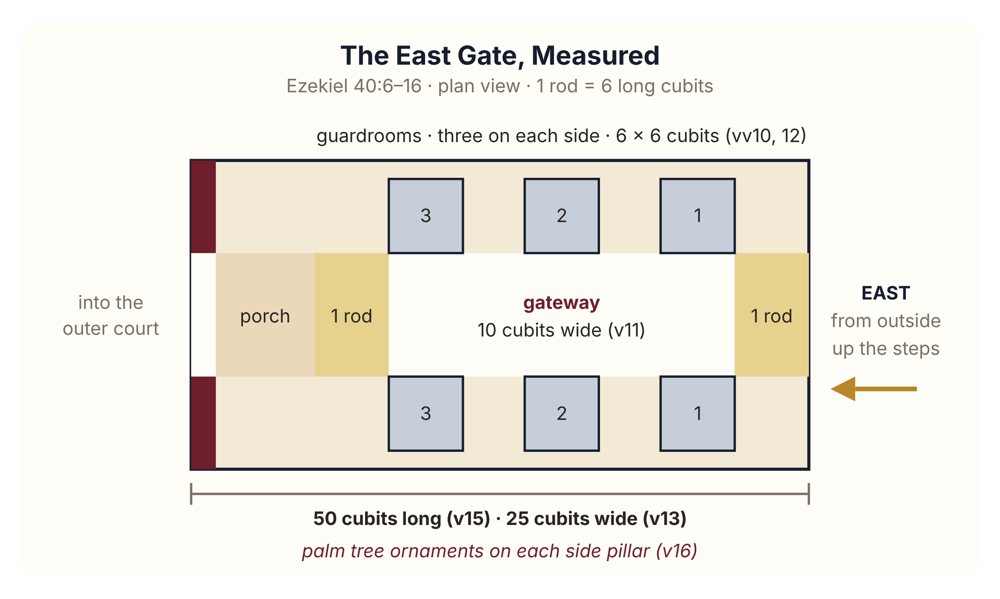
A New Temple Measured Out

Fourteen years after the temple burned, God took Ezekiel on a careful tour of a new one, and every wall, gate and step was measured because God was claiming it as His own. The ruins were not the end of the story — God already had the plans drawn for the place where He would dwell with His people again.

“Son of man, see with your eyes, hear with your ears, and give attention to all that I am going to show you; for you have been brought here in order to show it to you. Declare to the house of Israel all that you see.” Ezekiel 40:4
From the Ezekiel 41 study
Ezekiel 41

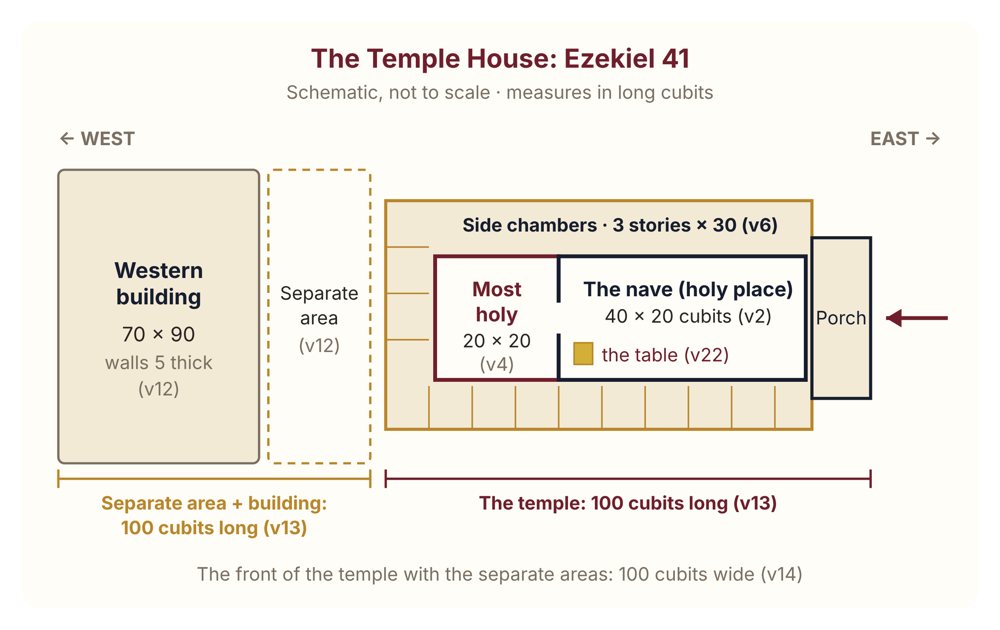
The Holy Place: The Table Before the LORD

God brought Ezekiel right up to the door of the most holy place and told him what was inside. The walls were strong, the rooms were ordered, and everything was carved with cherubim and palm trees, God's holy presence and God's life side by side, with a table before the LORD at the heart of it.

“And he said to me, ‘This is the table that is before the LORD.’” Ezekiel 41:22
From the Ezekiel 42 study
Ezekiel 42

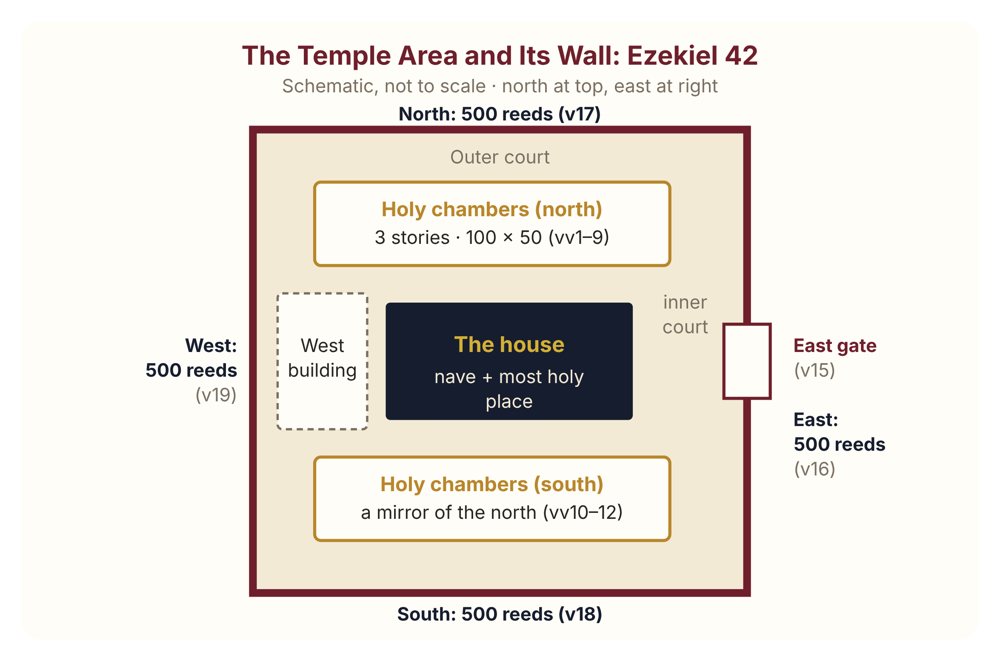
A Wall Between the Holy and the Profane

God measured a line around His house and put a wall on it to separate the holy from the common; His priests ate holy food in holy rooms and changed their clothes before they went back out to the people. In a nation that had blurred every line, God was drawing the line again.

“He measured it on the four sides; it had a wall all around, the length five hundred and the width five hundred, to divide between the holy and the profane.” Ezekiel 42:20
From the Ezekiel 43 study
Ezekiel 43

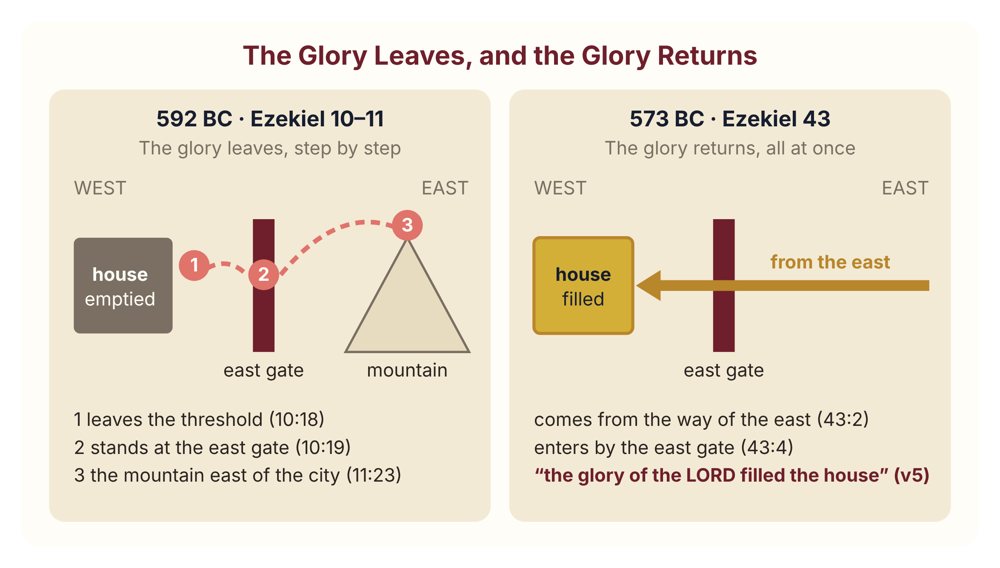
The Glory Comes Home

The God who walked out of His defiled house comes back the same way He left and fills it with glory, but He comes back to a holy house built around an altar where blood is shed and sin is dealt with. The road home to God's presence always runs through shame for sin, cleansing by blood, and then the word every prodigal longs to hear: “I will accept you.”

“And the Spirit lifted me up and brought me into the inner court; and behold, the glory of the LORD filled the house.” Ezekiel 43:5
From the Ezekiel 44 study
Ezekiel 44

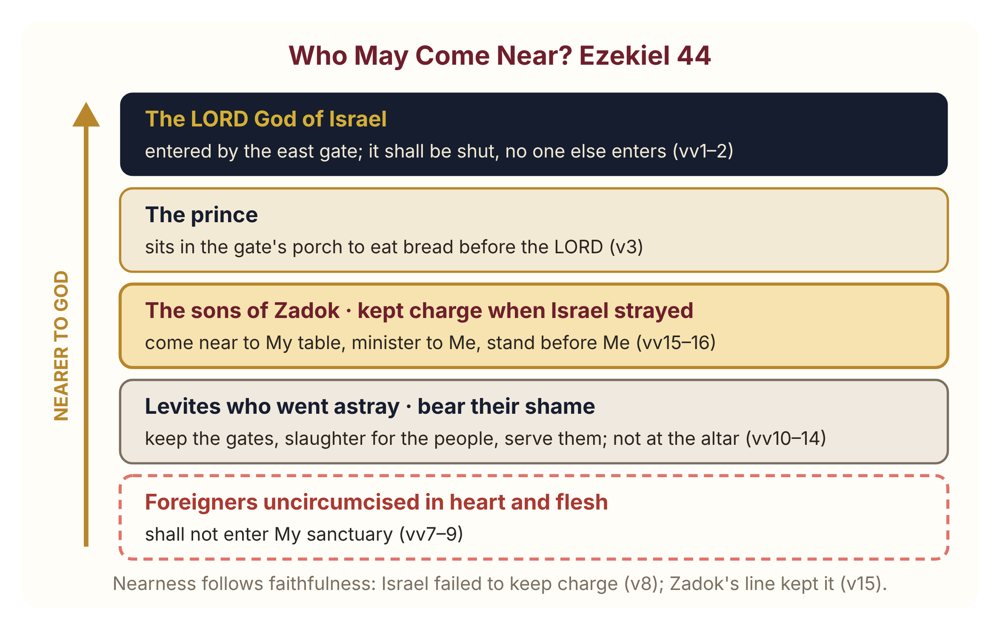
The Shut Gate and the Faithful Priests

In God's house, nearness is the reward of faithfulness: the Levites who led Israel into idolatry are forgiven enough to keep serving but not trusted to stand at the altar, while the sons of Zadok, who stayed true when everyone else drifted, get the best thing God can give, God Himself. Faithfulness in the dark seasons shapes what my service looks like later.

“And it shall be with regard to an inheritance for them, that I am their inheritance; and you shall give them no possession in Israel—I am their possession.” Ezekiel 44:28
From the Ezekiel 45 study
Ezekiel 45

Holy Land, Honest Rulers

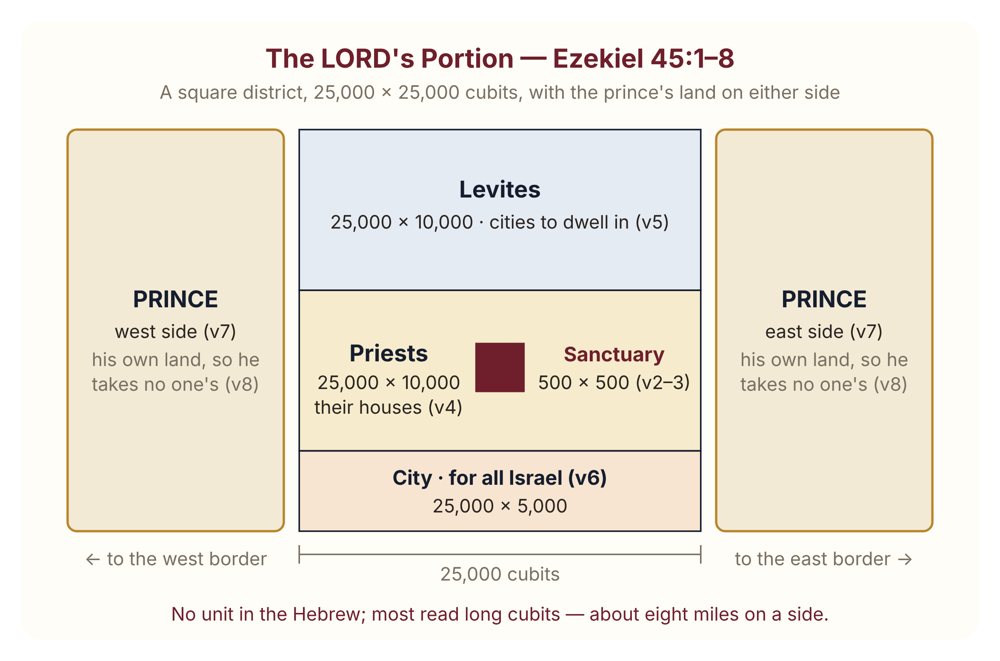
When God sets up His kingdom, He starts at the center — His holy house — and works out to the land, the city, the ruler, the market scale and the feast calendar. The leaders who used to grab and crush now give and serve, because holiness in worship and honesty in business go together.

“Thus says the Lord GOD, ‘Enough, you princes of Israel; put away violence and destruction, and practice justice and righteousness. Stop your expropriations from My people,’ declares the Lord GOD.” Ezekiel 45:9
From the Ezekiel 46 study
Ezekiel 46

The Prince and the Gate: Morning by Morning

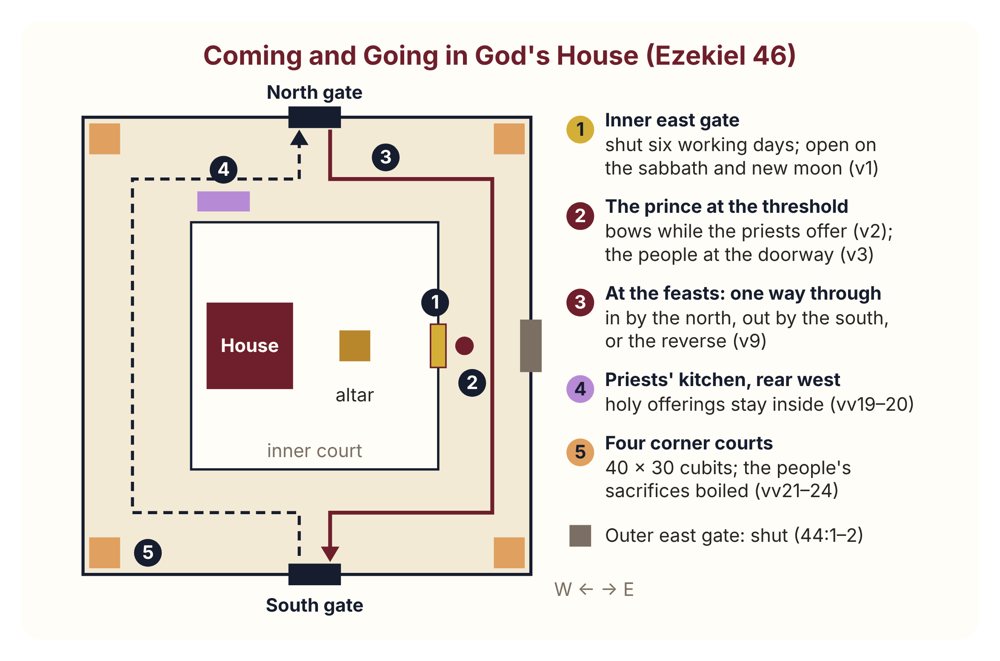
God puts order into worship — when to come, how to enter, what to bring, where to eat — and He puts limits on power, so the ruler worships beside his people and may not take what is theirs. Worship is daily, every morning, and no one leaves it the same way he came in.

“But when the people of the land come before the LORD at the appointed feasts, he who enters by way of the north gate to worship shall go out by way of the south gate. And he who enters by way of the south gate shall go out by way of the north gate. No one shall return by way of the gate by which he entered but shall go straight out.” Ezekiel 46:9
From the Ezekiel 47 study
Ezekiel 47

The River from the Sanctuary: Everything Will Live

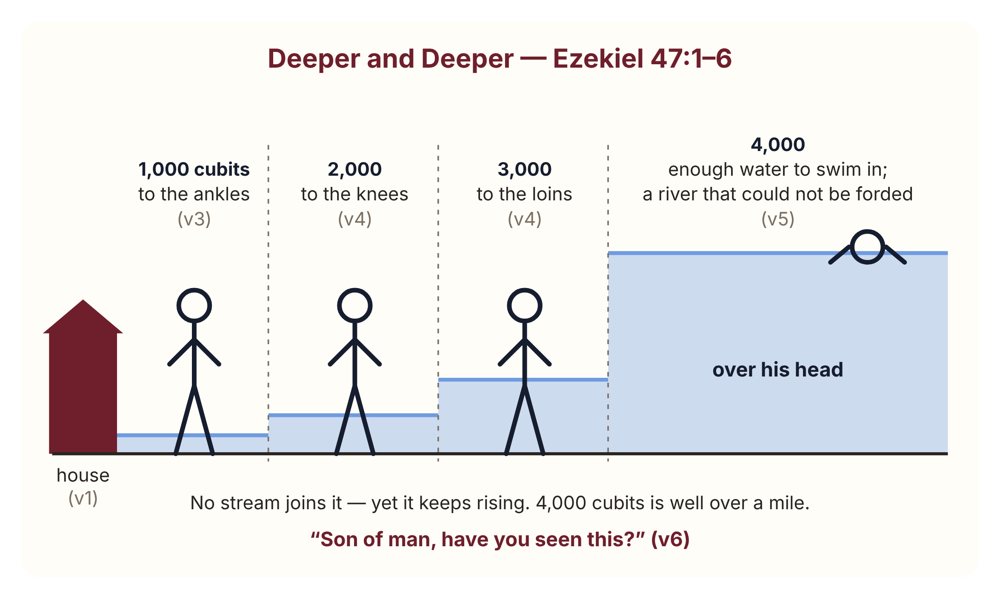
Life flows out of the place where God lives; it starts small, gets deeper the farther it goes, and heals everything it touches — even the Dead Sea — while only what refuses the river stays salt. And the God who gives the river also makes room in the land for the outsider.

“It will come about that every living creature which swarms in every place where the river goes, will live. And there will be very many fish, for these waters go there and the others become fresh; so everything will live where the river goes.” Ezekiel 47:9
From the Ezekiel 48 study
Ezekiel 48

The LORD Is There: Every Tribe a Gate

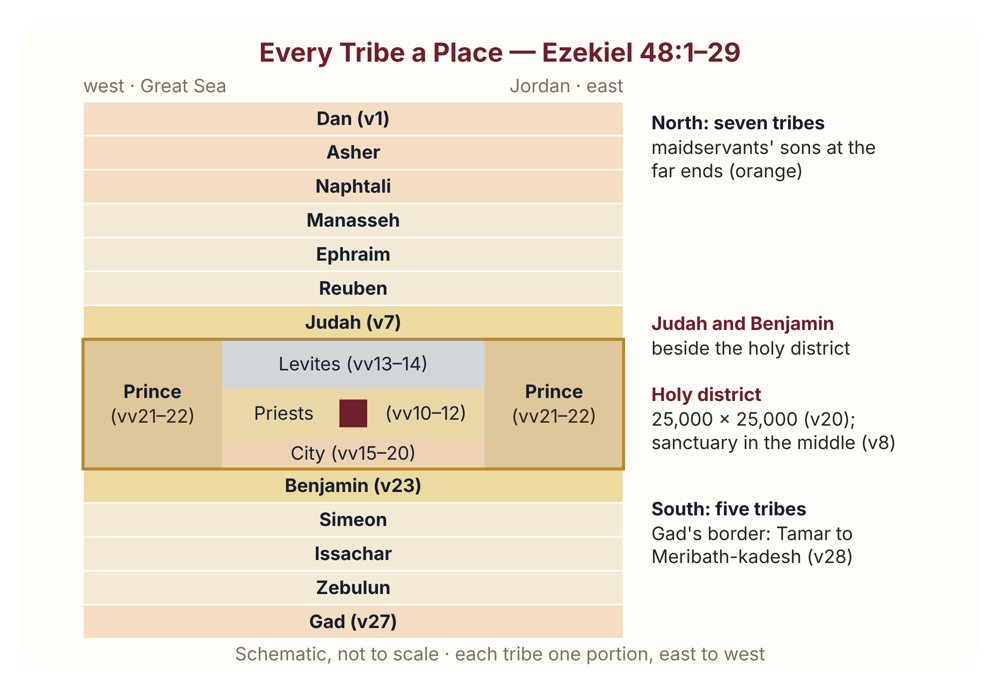
Every tribe gets a place, every tribe gets a gate, and God's house sits at the center of it all. Ezekiel's book began with exiles far from home and the glory leaving the city; it ends with a city whose very name is “The LORD is there” — God with His people.

“The city shall be 18,000 cubits round about; and the name of the city from that day shall be, ‘The LORD is there.’” Ezekiel 48:35

Take the whole book with you

The teacher voice in these studies is David Guzik (Enduring Word), with the writers he quotes — Charles Feinberg, Daniel Block, John Taylor and others. Scripture is quoted from the NASB 1995.